Disclaimer: The views expressed here are my own and are not related to or reflective of my work or any organization I am affiliated with.
Most companies did not redesign engineering for AI. They added AI to the same operating model they already had.
The autocomplete got faster. The pull request summaries got cleaner. The org chart stayed the same.
That is where the value gets lost.
McKinsey’s 2025 Global AI Survey found that 88% of organizations now use AI in at least one business function, but only about a third have begun to scale it operationally. The gap between adoption and operational redesign is where the productivity gains are sitting.
A smaller group is doing something else. They rebuilt the team around the assumption that AI will write an increasingly large share of the first draft.
From the outside, the new shape looks strange. Smaller pods. Blurred roles. No multi-quarter roadmaps. Fewer meetings. A different definition of what an engineer does.
The leaders running them describe it as the future.
Here is what that org looks like, dimension by dimension.
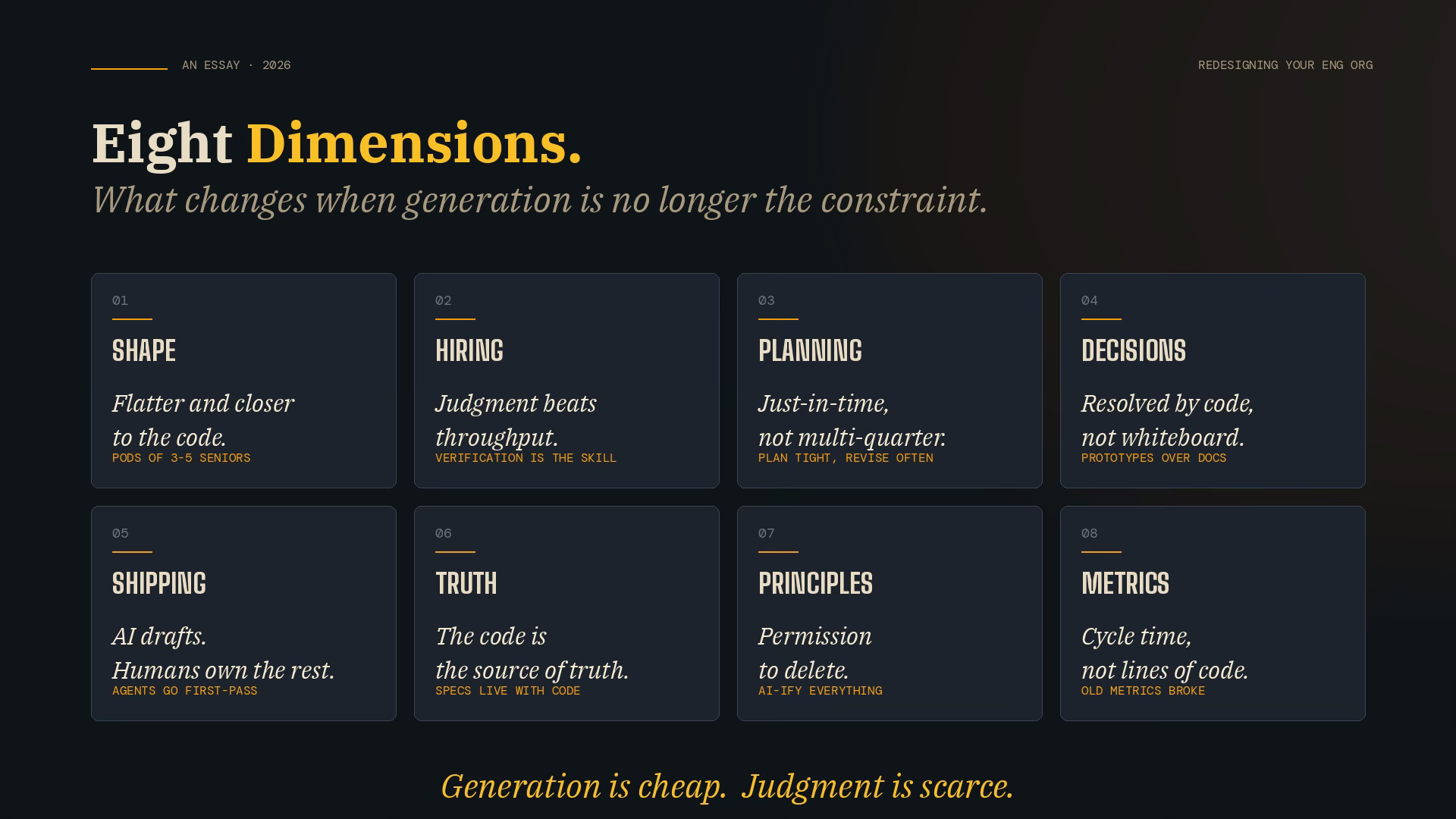
Shape: Flatter, smaller, closer to the code
The 8-to-12 person team was designed for a world where humans wrote every line. That world is ending.
Developer productivity research from DX in early 2026 shows AI-assisted commits climbing as a share of new code each quarter. Public commentary from large tech CEOs echoes the same observation: projects that used to need big teams can now move with one or two engineers and a fleet of agents.
The new shape is small pods of three to five engineers. High autonomy. Roles that deliberately blur.
Product managers ship code. Engineers draft copy. Designers prototype in production frameworks. Managers stay close to the work, not floating in a meeting layer above it.
When the cost of producing a working version drops near zero, coordination becomes the dominant tax. You reduce it by removing layers, not by adding ceremonies to manage them.
Hiring: The bar has moved from speed to judgment
The bar has not lowered. It has moved.
The new bar is not how fast you produce code. It is how reliably you judge it.
Two profiles are now disproportionately valuable.
The creative builder with deep product sense. The one who can hold the whole user experience in their head and direct AI to build toward it.
The deep systems expert. The one who understands the substrate well enough to catch the subtle failure modes AI introduces.
Sonar’s 2026 State of Code Developer Survey, drawing on responses from over 1,100 developers globally, found that 96% do not fully trust the functional accuracy of AI-generated code. That distrust is now a skill, not a personality trait. It is what stops you from shipping the convincing-looking bug AI is so good at producing.
The highest-leverage growth path now runs through judgment. Engineers who lean into review, design taste, and verification compound the fastest. The career arc did not shrink. It tilted toward the work AI cannot do for you.
That work has always been the most interesting work.
Planning: Just-in-time, not multi-quarter
Rigid roadmaps are an artifact of slow execution.
When a six-week feature ships in days, a twelve-month plan is a guess wearing a confidence interval. Senior tech leaders say the same thing in public: the era of build-it-once-and-forget-it is over.
The teams that rebuilt plan tightly. They use the freshest information available. They revise constantly.
They do not abandon strategy. They abandon the idea that strategy must be expressed as a Gantt chart eighteen months out.
The strategic horizon stays long. The commitment horizon shrinks.
Decisions: Resolved by code, not by whiteboard
This is the change that surprises people most.
In the old model, technical debates were settled in design reviews. Engineers wrote docs. Slack threads sprawled. Opinions piled up. Weeks later, something got built.
In the redesigned model, when two senior engineers disagree, the answer is the same. Build three versions. Compare real impact. Decide.
Generate the pull requests. Measure them.
The cheapest argument is the one you stop having because the artifact is sitting in front of you.
Most design docs get replaced by prototypes. The ones that survive capture genuinely irreversible architectural decisions. Everything else moves into the build.
Shipping: AI generates the first draft, humans own the hard parts
AI now generates a rising share of new commits. Leading AI labs have publicly documented multi-agent architectures running in production: parallel agents read the codebase, one writes the implementation, another runs the tests, another reviews the result. All in parallel. All coordinated.
The engineer’s role expanded. It did not shrink.
Engineers now spend more time on the parts of the job AI is bad at. Legal and security constraints. Trust boundaries. System architecture. Product taste. The judgment calls about what should not be built at all.
The agent is the first-pass implementer. The engineer is the reviewer, the editor, the source of direction.
You are not coding anymore. You are supervising.
That is not a downgrade. It is a promotion most engineers have wanted for years.
Source of truth: The code itself
Documentation has always lagged reality. The pattern in the redesigned orgs does not patch that gap. It eliminates it.
The repository is the source of truth.
A feature spec becomes a checked-in markdown file. Acceptance criteria become testable constraints. Agent instructions live beside the service they govern, in files like AGENTS.md or CLAUDE.md. Schemas, conventions, and architectural guardrails all sit alongside the code they describe.
When an agent needs to know how something works, it reads the code and the spec together. So does any human.
Wiki pages that quietly went stale six months ago are not a problem to patch. They are a category to delete.
The investment shifts. From writing documentation, to structuring the codebase so AI and humans can both navigate it.
The first is busywork. The second is leverage.
Operating principles: AI-ify everything reasonable, kill outdated rituals
The most underrated principle in the redesigned playbooks is permission to delete.
Standups that no longer serve. Status meetings that exist because they have always existed. Approval chains designed for a slower delivery model. Tools that solve problems the team no longer has.
Rituals do not retire themselves. Someone has to be explicitly empowered to end them.
The redesigned orgs make that empowerment a stated value, not an act of courage.
The other half of the principle is that everyone uses the tools. Not “engineers have access to a coding assistant.” Everyone.
Product managers prompt agents to draft specs. Designers generate prototypes in code. Recruiters automate screening. Legal teams summarize contracts.
The goal is not democratized AI literacy as an HR initiative. It is a shared operating fluency that lets the whole org move at the speed the tools allow.
Measurement: Cycle time, quality, reliability, failure rate. Not lines of code.
Old metrics were proxies for output in a world where output was scarce. Lines of code. Commits per week. Story points.
None of these survive contact with AI-generated work.
Developer productivity research shows teams now merge far more pull requests, each far larger than before. Volume metrics are meaningless.
The teams that rebuilt measure what actually matters.
How long for a new engineer to become productive. How long from PR opened to PR merged. The change failure rate. How often a deploy causes an incident.
The new metrics describe whether the system is healthy. The old ones described whether people were busy.
A new category of developer tooling now tracks AI-generated code attribution, agent effectiveness scores, and where agents are struggling in the codebase. The signal moved from individual productivity to organizational readiness for agentic delivery.
The bottleneck has shifted
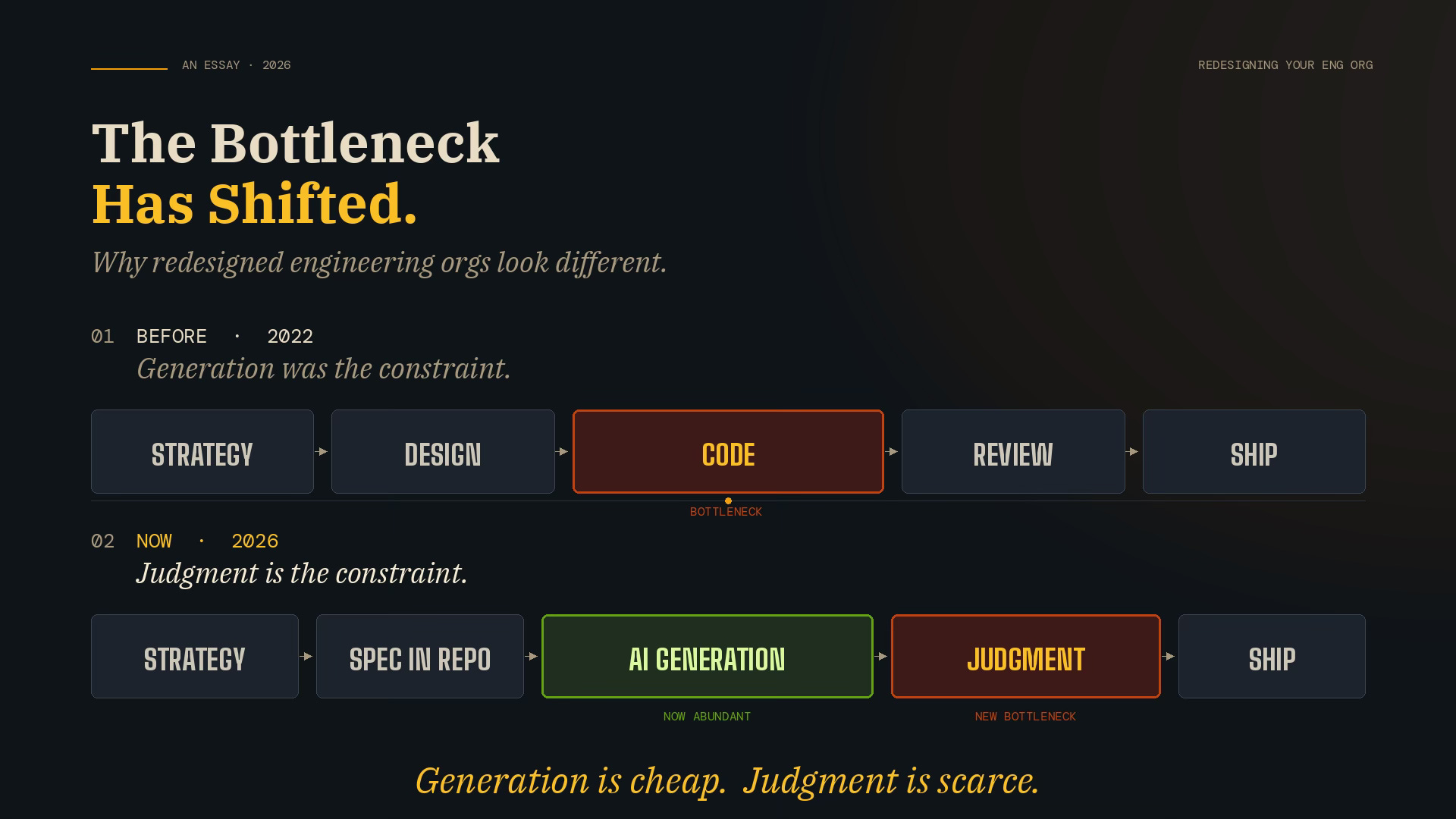
Here is the underlying insight. The one that explains everything above.
For thirty years, the constraint on shipping software was generation. We did not have enough engineers, or fast enough engineers, or organized enough engineers, to produce the volume of code the business wanted.
Most of the practices that define modern engineering organizations were optimized to relieve that constraint. Sprint planning. Code review. Hiring funnels. All of it.
That constraint is gone.
The new constraint is judgment. Taste. Verification.
It is the ability to look at fifty pull requests an agent generated last night and decide which three are worth merging, and why.
It is knowing what should not be built.
It is catching the subtle architectural drift AI introduces, because AI does not know what the system is supposed to feel like in five years.
Researchers have named this the engineering productivity paradox. Massive volumes of AI-generated code creating new technical debt. The work moving from creation to verification. A 2026 ICSE paper by Kohl and Carro, When Code Becomes Abundant, makes the same argument: the discipline must redefine itself around orchestration and verification, not production.
The Pragmatic Engineer’s 2026 AI tooling survey, with over 900 responses, found the same trust gap. A majority say AI produces code that looks correct but is unreliable. Trust dropped year over year even as adoption surged past 80%.
The verification gap is real. It is widening.
Organizations pulling ahead are not pushing more code through an unchanged pipeline. They are redesigning the pipeline around the new constraint.
Smaller pods. More autonomy. Less ceremony. More verification. Sharper judgment. A bet that taste, product sense, and verification skills compound over time.
McKinsey’s follow-on reporting is direct: leading AI-driven software organizations are seeing 16 to 30% faster time to market and 31 to 45% higher software quality than their peers.
Those gains come from teams that rebuilt, not teams that bolted AI on.
The transition is not a tooling rollout. It is an operating model change.
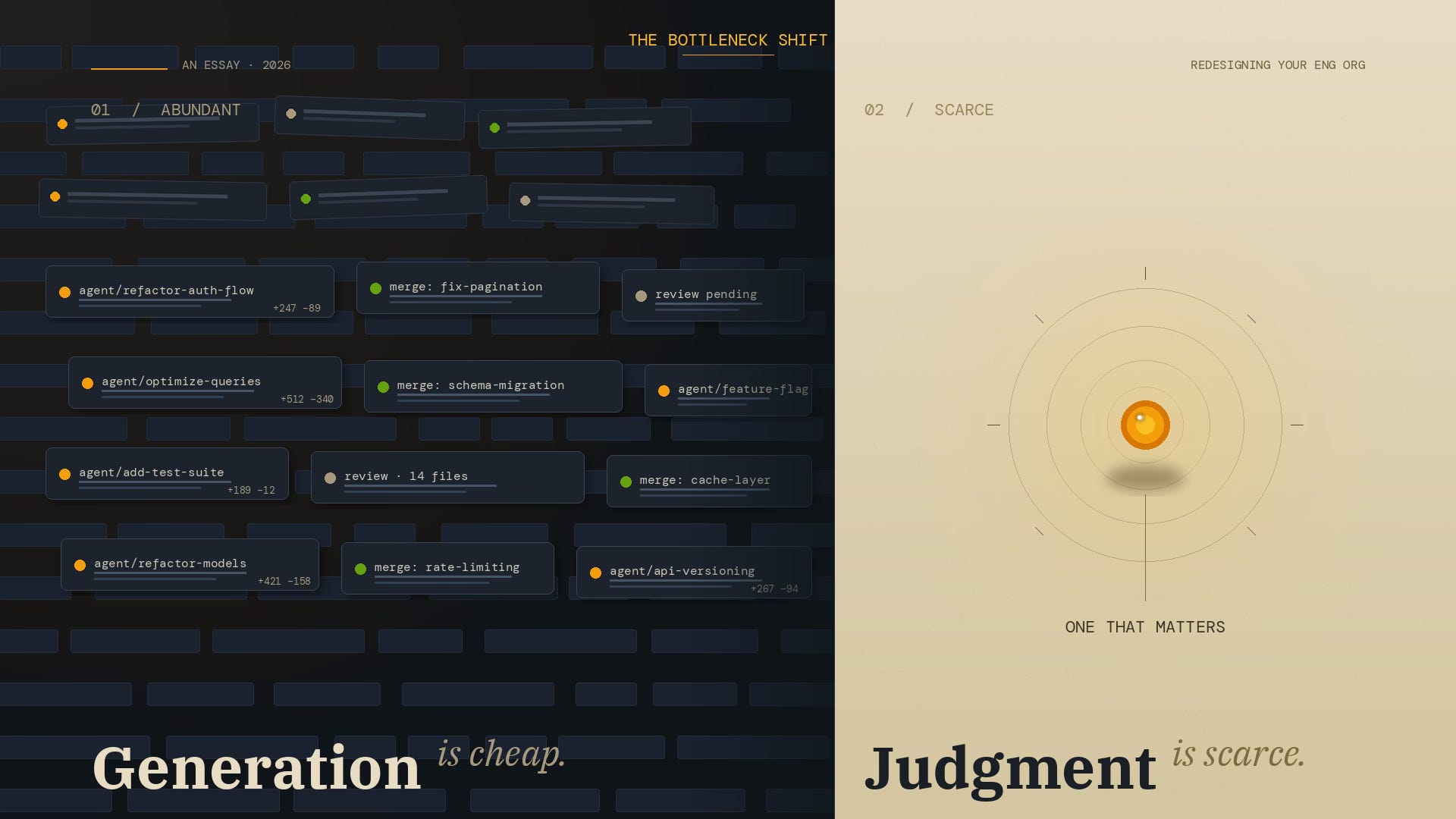
Generation is cheap. Judgment is scarce. The engineering org that wins this decade is the one redesigned around that truth.
Sources and further reading
McKinsey, The State of AI 2025: Agents, Innovation, and Transformation — AI adoption and scaling rates across 1,993 respondents in 105 countries. mckinsey.com/capabilities/quantumblack/our-insights/the-state-of-ai
Anthropic: Running an AI-native engineering org
Sonar, 2026 State of Code Developer Survey — 1,149 developers globally; the 96% trust gap; the “vibe, then verify” pattern. sonarsource.com/the-state-of-code/developer-survey-report
The Pragmatic Engineer, AI Tooling for Software Engineers in 2026 — 906 respondents; 95% weekly AI use; Claude Code overtakes Copilot. newsletter.pragmaticengineer.com/p/ai-tooling-2026
DX, Developer Productivity Research (2026) — AI code attribution, agent experience scoring, AI-assisted commit share. getdx.com
Stack Overflow, 2025 Developer Survey — broad AI adoption, trust dynamics, daily frustrations. survey.stackoverflow.co/2025
Deloitte, Tech Trends 2026 — shift from project to product, redesigning engineering for AI. deloitte.com/insights/tech-trends
Kohl & Carro, When Code Becomes Abundant: Redefining Software Engineering Around Orchestration and Verification (ICSE-FoSE 2026) — the academic case for the shift. arxiv.org/abs/2602.04830
Adevinta Engineering, A pragmatic evaluation of software engineering AI tooling (March 2026) — real enterprise pilot data on Cursor, Claude Code, Copilot. adevinta.com/techblog
Hi Madhu,
Really interesting piece, thanks.
One thing I’ve run into lately is that our tools were never built for AI development. As awesome as git is, the PR workflow does not work with a 150 file PR in a single commit. I’ve been writing some wrappers for it so separate the PR by feature and software layer. Seems to be helping - the PRs seem to be human reviewable (or at least comprehensible). It is here on GitHub https://github.com/predictable-labs/gait - appreciate feedback if you have time.
Thanks Patrick. I will check your repo and share my feedback.