Buying a car is something most of us do once every few years.
Selling cars is something a dealership does every day.
That difference matters.
The salesperson understands inventory, incentives, financing, trade-ins, fees, options, margins, and the psychology of getting a buyer to focus on a monthly payment.
I understand my work.
When I started shopping for a car, I realized I was entering a transaction where the other side handles this every single day, and I handle it once every few years. So I tried something different.
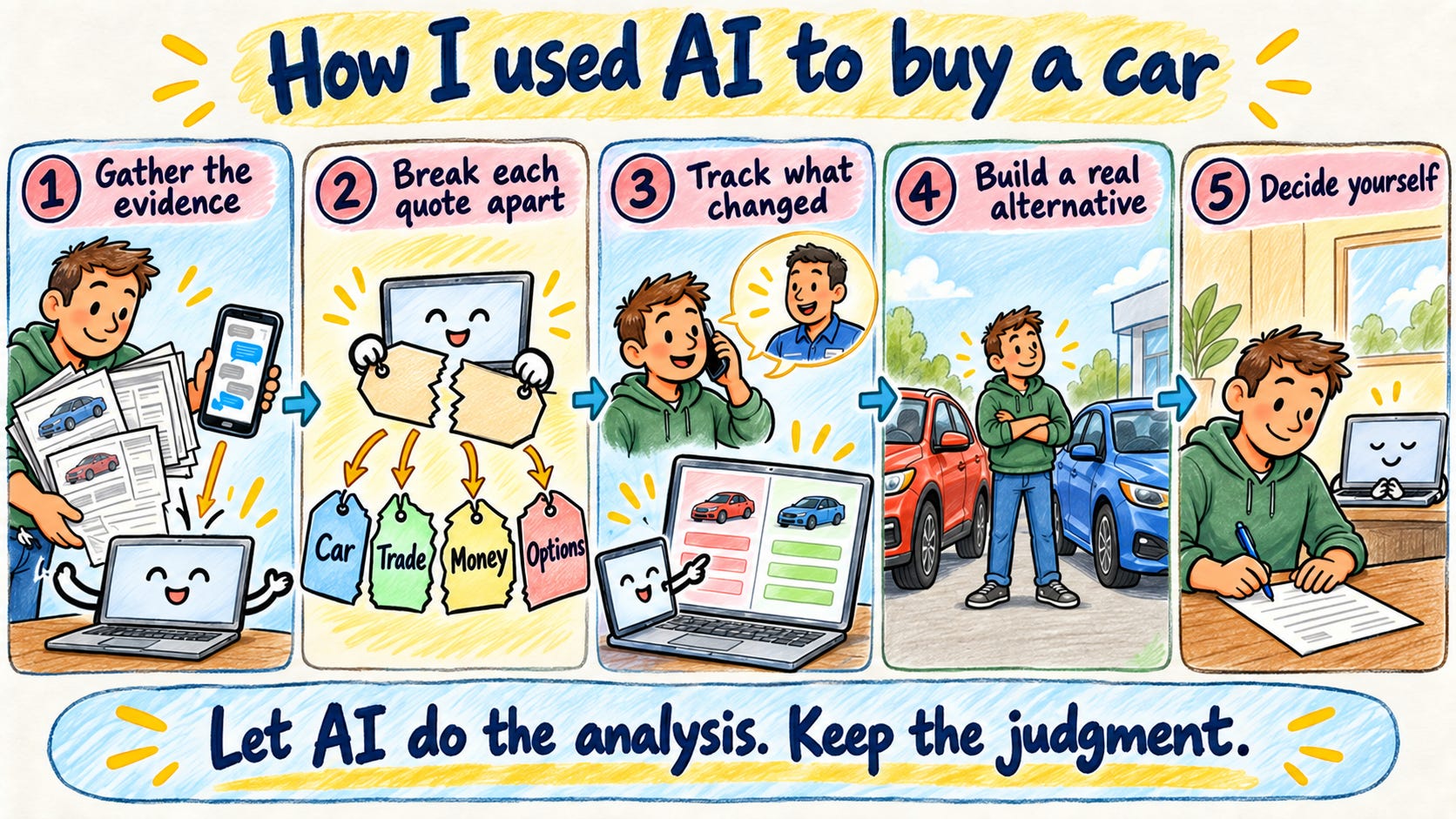
I brought AI with me. Not to negotiate on my behalf. Not to generate clever lines to send a salesperson. I used it as a thinking partner throughout the entire process.
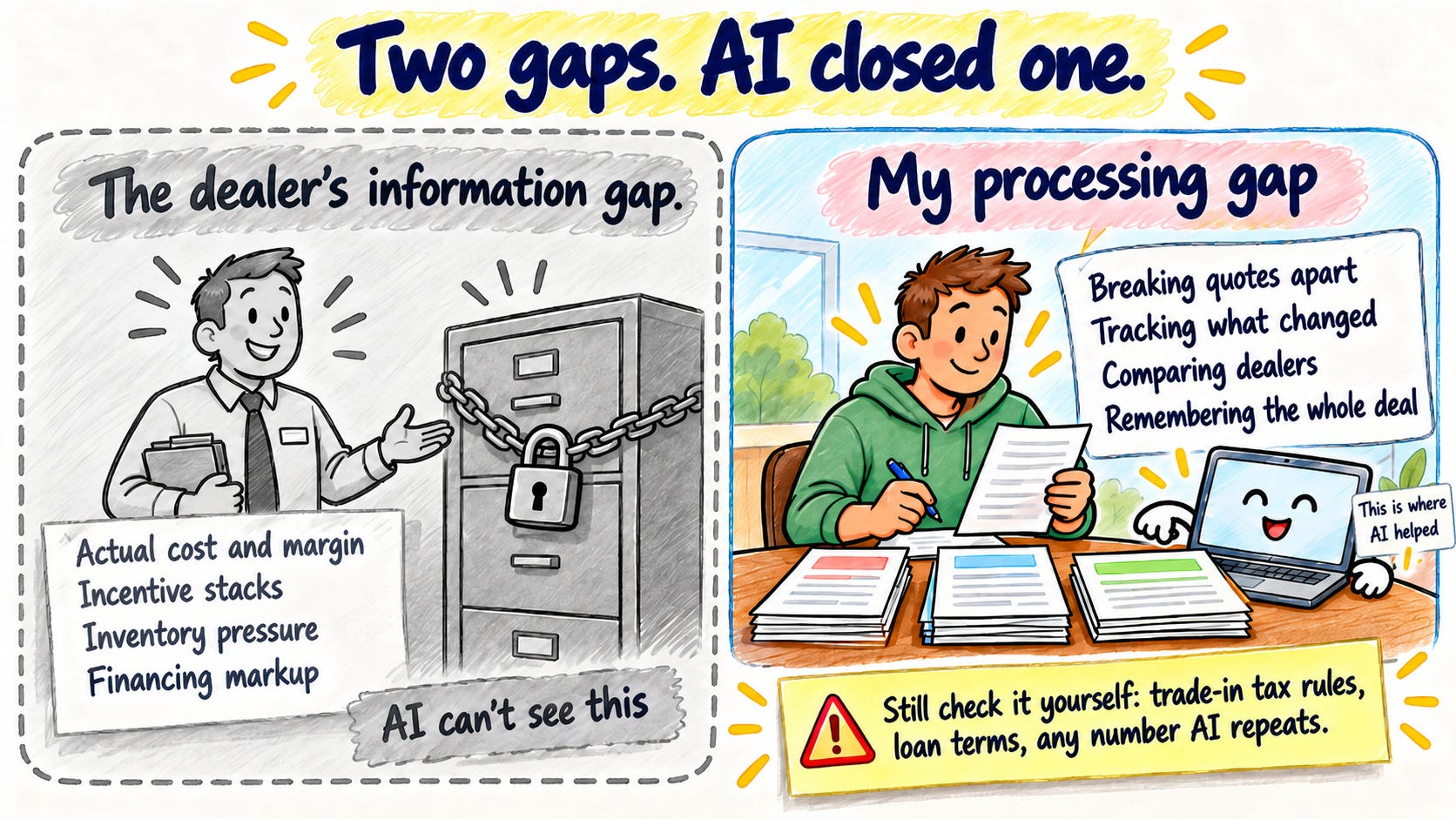
And somewhere along the way, I realized the interesting story wasn’t that AI helped me buy a car. The dealer’s edge is knowledge I still don’t have: inventory pressure, incentive stacks, actual margin. What AI closed instead was my processing disadvantage.
The Problem Wasn’t Finding a Car
Finding cars is easy. Every manufacturer and dealer has inventory online. There are marketplaces, reviews, pricing sites, forums, and endless opinions.
The difficult part begins once you have several cars you would actually buy. They aren’t identical. One has different options. Another has a larger discount. Another dealer offers more for your trade. One quote includes fees that another doesn’t. One salesperson talks about the selling price. Another talks about the amount due. Another wants to discuss the monthly payment.
Then there’s financing, taxes, and incentives, and suddenly you’re comparing things that look comparable but aren’t.
This is where I started using AI differently. Instead of asking “Is this a good deal?” I gave it the evidence: window stickers, dealer worksheets, screenshots, trade-in offers, financing terms, messages from salespeople. Then I asked it to tell me what was actually happening in the deal. That changed how I worked, even if it didn’t change what I knew.
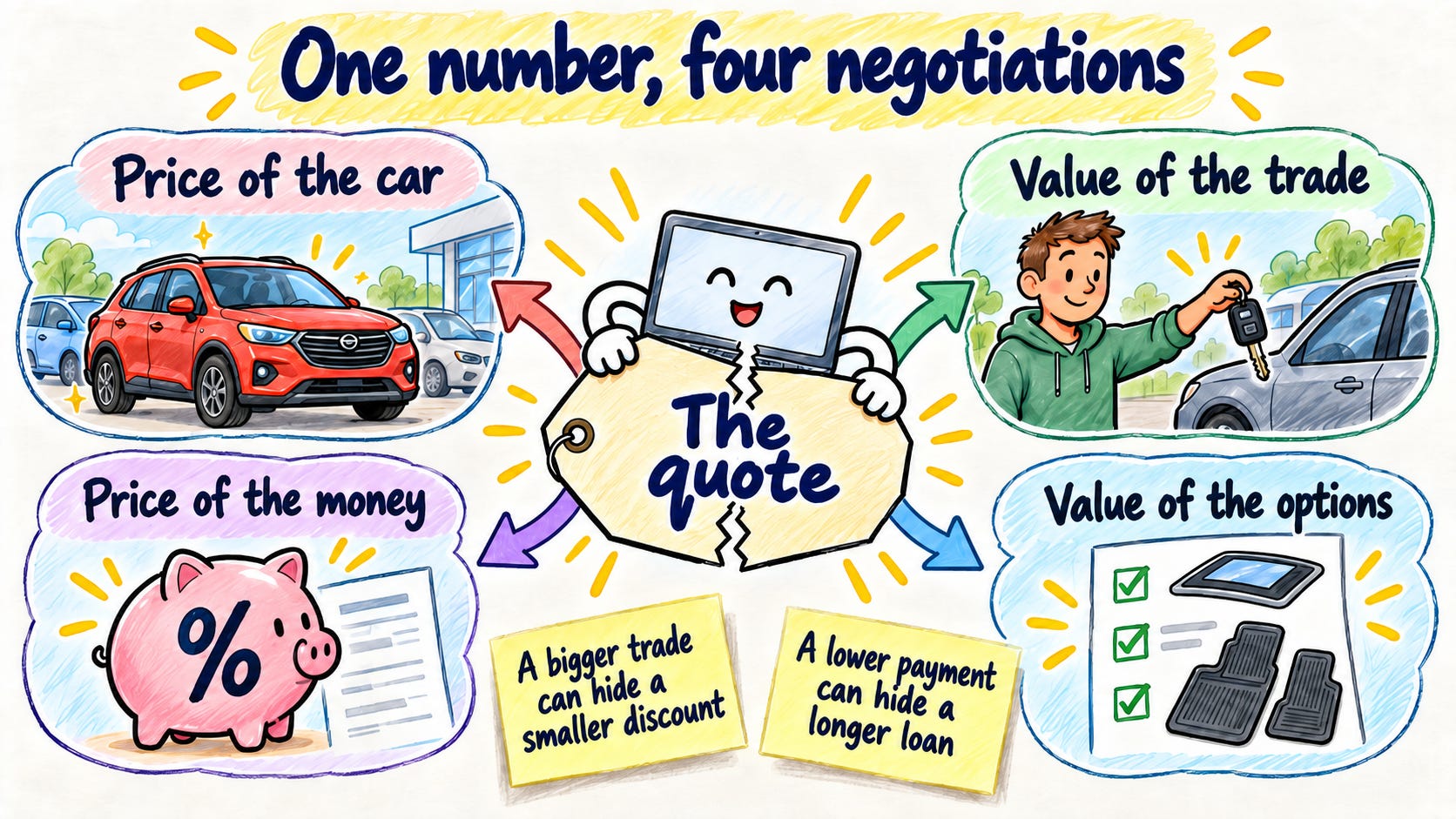
What each dealer was doing, underneath the different language, was the same thing: presenting one number (a price, a payment, a trade value) while moving value between four separate buckets. The car has a price. The trade has a value. The money has a price. The options have value. That decomposition isn’t something AI invented. It’s the out-the-door-price advice every consumer finance site gives, run in reverse: a dealer’s “four-square” worksheet works by keeping those buckets bundled so you never see the whole picture at once. What AI added wasn’t the idea. It was doing that decomposition fast enough, on a messy screenshot, to use it while the salesperson was still on the phone.
What AI Actually Did
Every time I received a new offer, I dropped it into the conversation and asked what changed from the previous one, whether the dealer was discounting the vehicle or just moving trade value around, and whether two vehicles were really comparable once their equipment was accounted for. Instead of trying to remember everything, I had a running model of the negotiation that updated as new offers came in.
That mattered because negotiations move fast. A salesperson calls. Another dealer sends a message. A trade offer changes. Normally I would have reopened spreadsheets, reread old quotes, and tried to reconstruct the picture from scratch. Instead I could say “they just changed this, what does it mean” and get an answer against everything that had already happened, not against a blank page.
The value compounded as the negotiation went on. I wasn’t handing a screenshot to a generic chatbot that knew something about cars. I was handing it to a conversation that already understood this deal’s history, which is a different thing.
It also raised questions I hadn’t been asking on my own: whether I was comparing the same equipment, whether I was negotiating the payment instead of the transaction, what happened if I separated the trade from the purchase and the financing from both. Those are the same questions a good CFPB worksheet would put in front of you. The difference is that a worksheet doesn’t know your specific quote; a conversation that’s been holding your specific quote for two weeks does.
None of this was error-free. Trade-in tax treatment varies by state and I had to double check anything the model told me there, and financing math depends on inputs (APR, term, dealer reserve) that a dealer doesn’t disclose and that no LLM can see either. The AI could tell me what a quote implied. It couldn’t tell me what the dealer’s actual cost or margin was, and it got specifics wrong often enough that I stopped taking a number at face value until I’d checked it against the document it came from.
Competition Became More Powerful Than Negotiation
Somewhere in the middle of this, I stopped spending most of my effort trying to talk a dealer down and started spending it building a real alternative: finding another acceptable car, understanding its configuration, getting a real offer, and normalizing that offer against the first one until I knew exactly what I’d gain and give up by choosing either.
There’s a difference between asking “can you do better?” and knowing “I have another option I’m genuinely happy to buy.” AI made the second statement true faster, by researching the alternative and running the comparison. But it’s worth being precise about what did the work: the second option is what created the leverage. AI just made it cheaper to build and verify. This is also not a new idea. Negotiators have a name for it, a credible alternative to walking away, and not needing the deal is still the oldest lever in the room.
The Human Kept the Judgment
AI could tell me one vehicle had more equipment. It couldn’t tell me how much I’d enjoy that equipment. It could calculate the economic gap between two offers. It couldn’t tell me how much that gap mattered to me. It could tell me a deal looked competitive against the other quotes I’d fed it. It couldn’t tell me what the dealer’s true floor was, because it never had access to that number.
Let AI do the analysis. Keep the judgment.
That held throughout. AI researched, compared, calculated, and remembered. I decided what I valued, and I made the final call.
This isn’t really a story about cars. What changed was my decision-making bandwidth, not the amount of automation. Very little was actually automated; the AI didn’t buy anything for me. The same asymmetry, a professional who does the transaction constantly against a buyer who does it rarely, plausibly shows up in other places too (mortgages, insurance, contracting, comp negotiation), though I’ve only tested it on this one purchase and won’t claim it generalizes cleanly.
AI doesn’t turn a buyer into an expert. What it did here was let me borrow, for a few weeks, some of the information-processing speed a professional has by default. I still walked into every conversation as the one who does this once every few years. I just spent less of that time reconstructing the deal from memory and more of it deciding what I actually wanted.
This continues a thread from An Agent That Opens Its Own Gate Has No Gate: the agent does the work, the human still has to be the one standing at the gate.
The views expressed here are my own and are not related to or reflective of my work or any organization I am affiliated with.