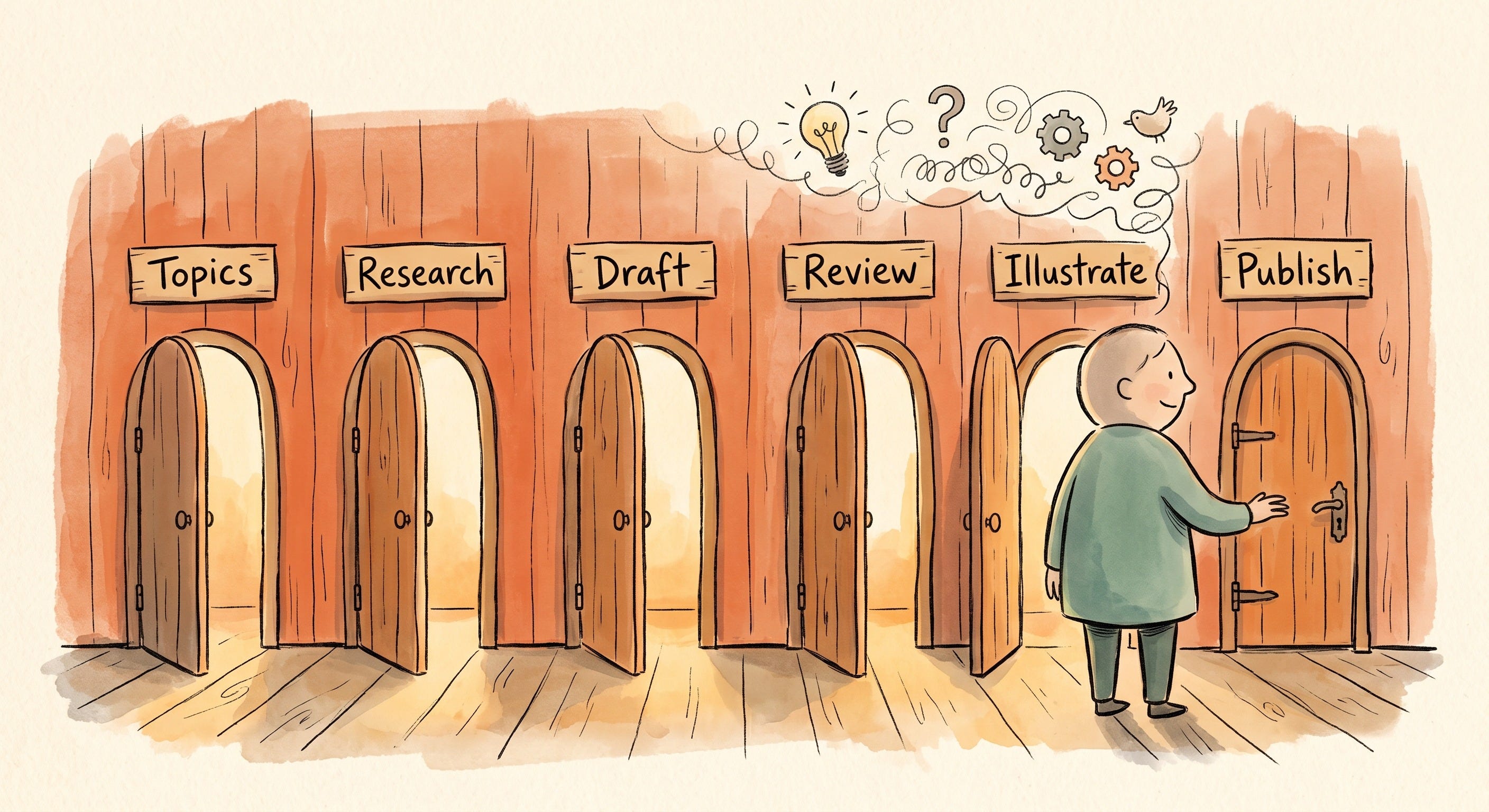
For as long as I can remember, I have wanted to write. The thoughts were always there: about systems, about work, about what technology was doing to both. What was never there was the ease of putting them on paper. I didn’t grow up with English as my first language. I know the language well, well enough that nobody at work would guess the friction, but knowing a language and composing in it are different taxes. Every sentence cost me two: one to think it, one to render it. The thoughts stayed in my head, where the rent was cheaper.
Knowing a language and composing in it are different taxes.
The rendering tax is gone for me now. Not lowered. Gone. Most weeks now, a post goes out under my name, and the cost that’s left is the one I would have paid anyway: understanding a thing well enough to put my name on it.
Not lowered. Gone.
This is the story of what removed it. The machinery is the smaller half; I will get to it.
I cannot fully separate the language tax from everything else that changed alongside it: a pipeline, a weekly habit, a reason to keep researching. Language is the tax I felt, so it is the one I am telling you about.
What it actually takes to be a blogger
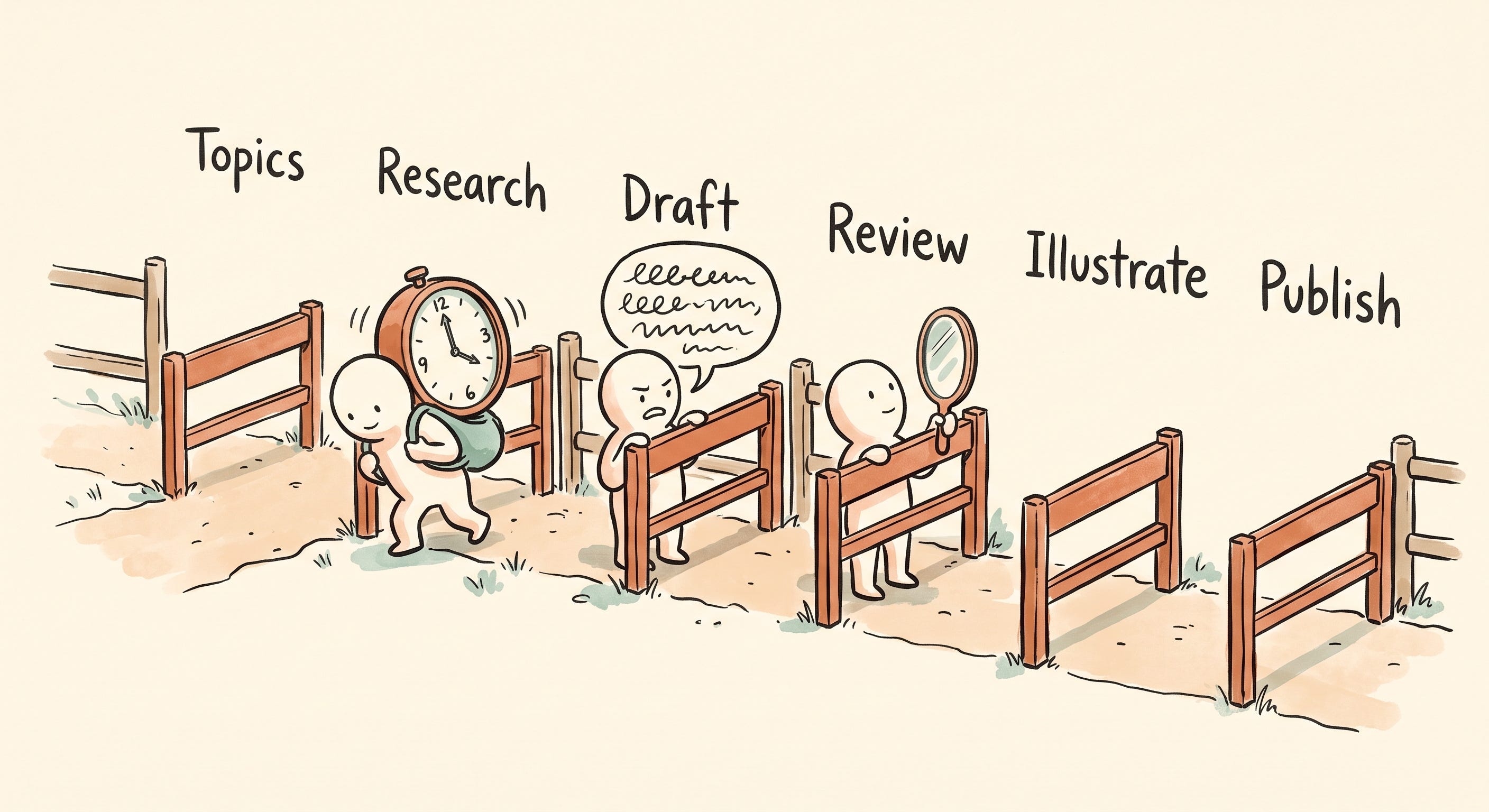
I used to think the barrier was writing. Then I tried to publish regularly and found out writing is one job of six.
You have to find topics worth anyone’s time, again and again. Research them: what’s already been said, what’s actually true, what you can add. Draft in a voice that sounds like you and not like everyone. Review your own work, which is notoriously hard to do from inside your own draft. Illustrate the ones that need it, because some arguments lose readers as a wall of text. Publish: the formatting, the images, the editor, the button.
Each job filters people out. The non-native speaker stalls at drafting. The busy engineer stalls at research. Almost everyone stalls at review, because honest critique of your own draft is the rarest skill on the list. Stack those six jobs together and it gets easier to see why so many people with something to say never publish it. They stay readers, not writers.
What the agents took off my hands
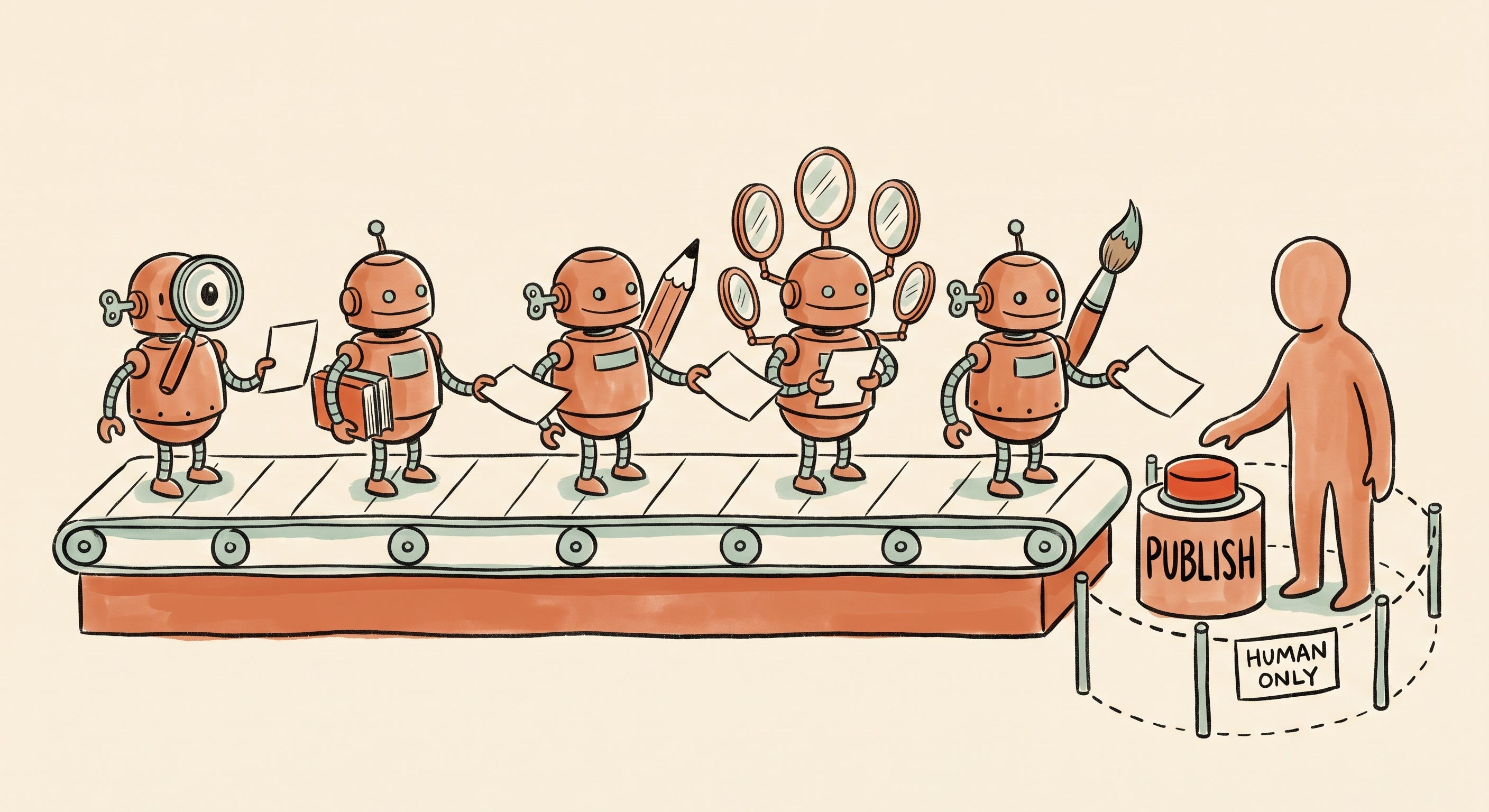
Every job but one turned into an agent: a small file of instructions run by Claude Code, each doing one job, several of them running in parallel.
A scout proposes topics, mining what’s new and what I’ve been circling without noticing. A researcher digs into one idea and comes back with a brief: what’s known, what’s contested, what the narrowest honest claim would be. A drafter writes in my voice, because my voice lives in files now, real posts I’ve written, hard rules, the habits I never want.
A critique panel reads the draft against the brief through four lenses: a skeptic attacking the argument, a domain expert checking the facts, a naive reader marking where they got lost, a voice editor guarding against generic AI prose. Sometimes other models read it too, ChatGPT and Gemini in my own browser, because a critic sharing the drafter’s weights shares its blind spots as well; they file their own dissent. A reviser folds it all in. An illustrator makes the figures. An assembler builds the post in the editor and stops.
The job that stayed human: Publish. That one is mine, on purpose.
None of these agents is impressive alone. Together they are the difference between me and every earlier version of me who wanted to write and didn’t. What I bring is a thought, a judgment, and the knowledge and experience that make the judgment worth trusting. What I get back is everything I was never going to make cheap on my own.
What’s real: the rendering tax is gone, and a post goes out most weeks. What isn’t gone: the browser stages still fight me with logins and session timeouts, they run one at a time because I haven’t parallelized them, and every claim the critics flag still has to be defended in words that are mine. “Gone” describes the language cost. It does not describe the operating cost.
The one ask: the understanding stays yours
Here is the rule I hold myself to, and the one thing I ask of anyone who takes this pipeline:
Do not publish what you do not understand.
The machinery makes it possible to ship a post about anything. That is exactly the danger. A pipeline can produce fluent paragraphs about a topic you half-know, and your name goes on them, and your name is the one thing the pipeline cannot manufacture. So the discipline is simple: if the researcher’s brief teaches you something, stop and learn it before the drafter touches it. If the critic panel flags a claim you cannot defend in your own words, it comes out.
My pipeline enforces a version of this mechanically, but only a version. After revision, it compares the brief against the finished draft and checks whether a claim narrowed, an assumption died, something moved. If nothing moved, it flags the piece as a summary wearing an essay’s clothes. What it is actually checking is whether the documents changed their minds. Whether I did is the one thing no gate can check. That’s why the rule above the gate is mine, not the machine’s.
Understanding leaves fingerprints. Whether they’re mine is the one thing no gate can check.
The rule had a side effect: it keeps me current. Researching a topic properly, every week, turned out to be the best professional habit I’ve kept in a field moving this fast.
The blog was supposed to be the output. The learning became the point.
You can be next
Everything above lives in a repo now, generalized: the agents, the orchestrator, a setup command that scaffolds your workspace and interviews you about your voice, and the writing-craft canon the critics use, with its sources cited. It’s a Claude Code plugin called blog-pipeline: github.com/madhusnagaraj/blog-pipeline. It runs inside Claude Code, the terminal tool Anthropic ships for working with Claude on real projects; point it at your own writing and it does the rest. It needs Claude Code set up and the patience to answer a few questions about your own voice. Nothing more exotic than that.
If your barrier was the same one, it is gone for you too. What’s left is the part that was always going to be the hardest, and the only part worth being hard: deciding what you believe, and standing behind it.
Every sentence used to cost me two. It costs one now, and it’s the one I would have paid anyway.
The views expressed here are my own and are not related to or reflective of my work or any organization I am affiliated with.