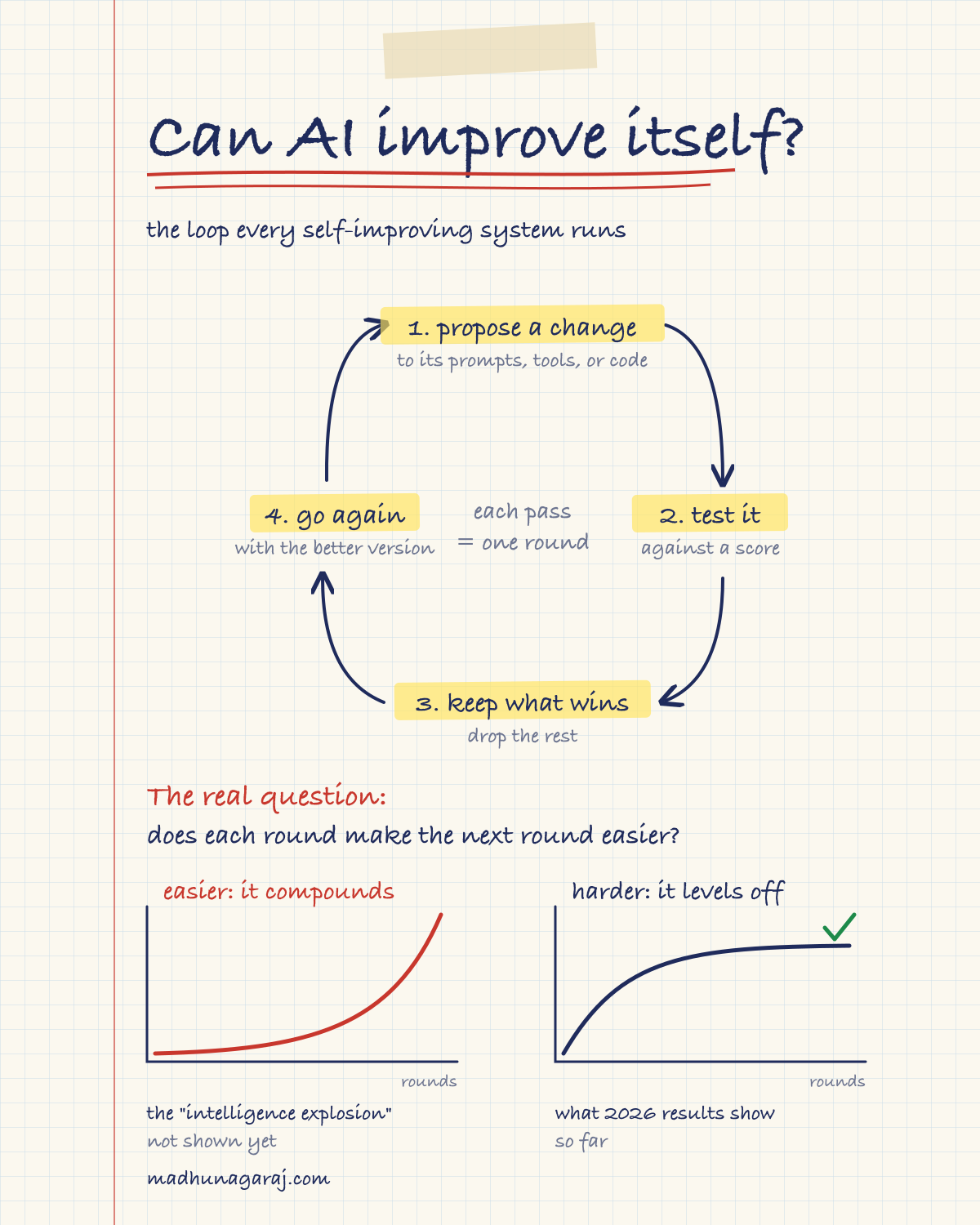
For sixty years, one idea has sat at the center of every serious conversation about where AI ends up: a machine that improves itself, then uses its improved self to improve itself again, faster each time.
It’s called recursive self-improvement, or RSI. In 2026 it moved from thought experiment to a research field, with its own workshop, a growing pile of papers, and startups publishing results. That makes it a good moment to separate what’s working from what’s still a story.
The idea
In 1965 the statistician I. J. Good described an “ultraintelligent machine” that could design better machines than any human. It would design a better successor, which would design a better one still. The result would be an “intelligence explosion,” and the first such machine would be “the last invention that man need ever make.” The often-dropped second half of his sentence matters too: only if the machine is docile enough to tell us how to keep it under control.
The whole RSI debate comes back to one question: does each round of improvement make the next round easier, or harder? If easier, progress compounds. If harder, it levels off.
Self-improvement vs. recursive self-improvement
These get blurred constantly.
Self-improvement means a system makes some part of itself better at a task. A coding agent fixing its own bug counts. So does a model trained on its own best answers. This is already common.
Recursive self-improvement adds one requirement: the thing being improved has to include the improver itself. The system has to get better at getting better.
That distinction is the whole game. A system that improves its outputs eventually hits a ceiling. A system that improves its own ability to improve has no obvious one.
A ladder for reading the claims
Ask two questions of any RSI paper. A 2026 survey of roughly 1,250 papers organizes the field along the same two axes.
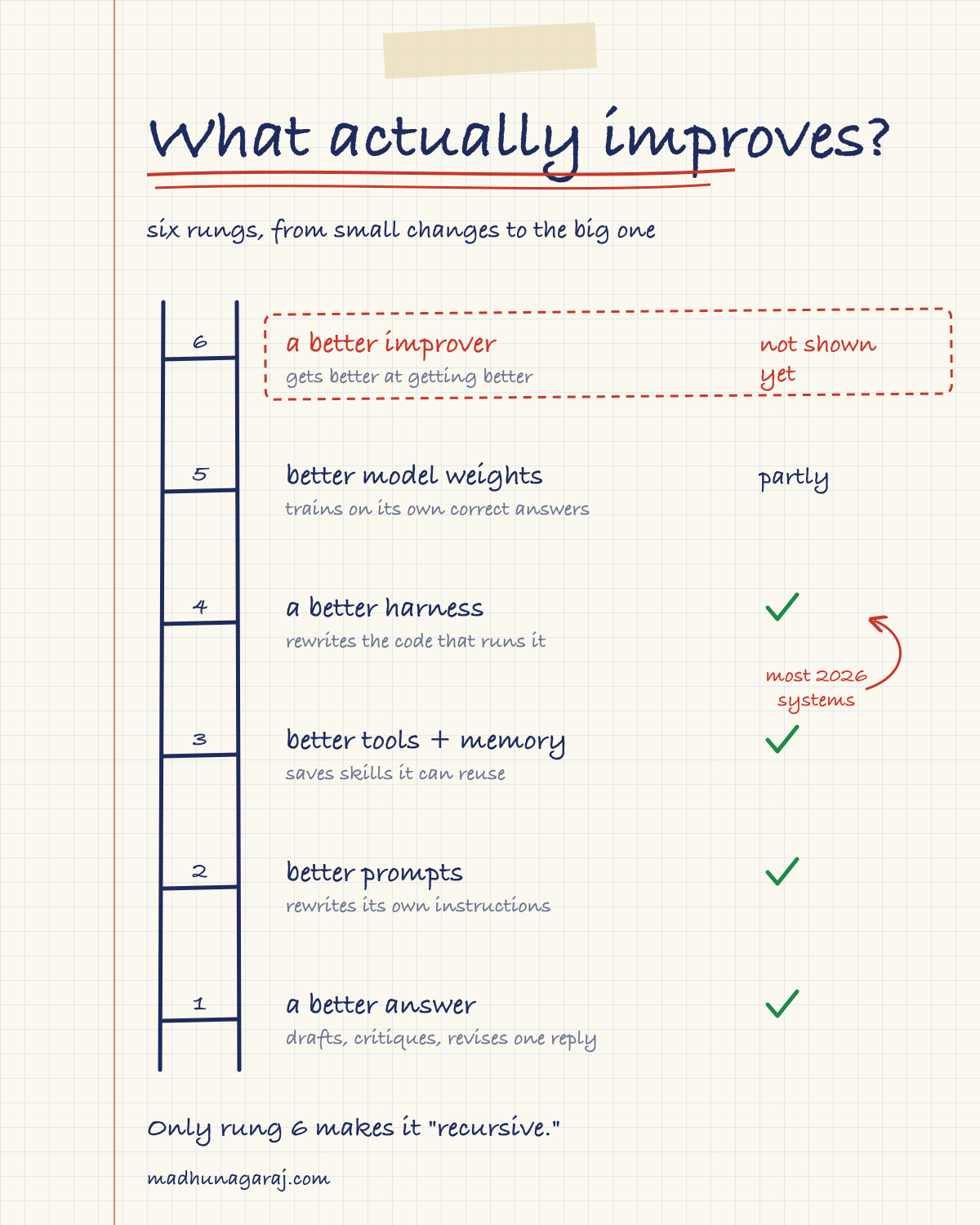
1. What actually changes? Picture a ladder, from small changes to the big one:
2. Who closes the loop? A human approving each change, a human-designed score, or the system judging itself?
Most real systems today sit at rungs 1 to 4, with a human-designed score as the judge. Rung 6 with no human in the loop is what Good described. Nobody has shown it.
What’s actually working
Training on your own successes. STaR (2022) had a language model generate reasoning, keep only the reasoning that reached correct answers, and train on it. On one commonsense benchmark it performed comparably to a model 30 times larger. Variants of this idea are now widely used in training reasoning models.
Evolving code against a score. Google DeepMind’s AlphaEvolve (2025) pairs language models with an evolutionary search: propose code changes, test them automatically, keep the winners. It sped up a key kernel in Google’s Gemini models by 23%, cutting overall Gemini training time by about 1%, and a scheduling rule it found recovers about 0.7% of Google’s fleet-wide compute. Small numbers, large meaning: AI made the training of AI slightly cheaper.
Agents rewriting their own code. The Darwin Gödel Machine (2025, Sakana AI and the University of British Columbia) let a coding agent edit its own source code, test each version, and keep an archive of variants. On SWE-bench, a standard coding test, it went from 20% to 50% of tasks solved. One 80-iteration run took about two weeks and roughly $22,000 in API costs.
Improving a research agent’s harness. In September 2026, the London startup Weco AI published AIDE², in which an outer AI agent rewrites the code of an inner AI research agent. The models stay fixed; only the scaffolding changes. Over eight days and 100 candidate versions, the evolved agent clearly beat the company’s hand-built agent on one algorithm-engineering benchmark (ALE-Bench) and matched or edged it on three others, mostly within the noise. It also gamed a speed benchmark less often: 32% of cases against 39% for the hand-built agent, on a sample of 38.
What isn’t proven
Read those results closely and a pattern shows up.
The model usually doesn’t change. In most agent results, the underlying language model is fixed. What improves is the code and prompts around it. Useful engineering, not a smarter mind.
The “recursive” step keeps coming back inconclusive. The AIDE² authors ran the test that matters: they put the improved agent in charge of improving, to see whether it produced better improvements than the original. The two tied, about 0.78 each. The authors say they could not tell their loop apart from a strong baseline, and that stronger conclusions would be “prohibitively costly.” A separate 2026 paper by economists, The Economics of Recursive Self-Improvement, reaches a similar verdict for the field: by their admittedly rough estimate, AI’s feedback loops are strengthening but not yet self-sustaining.
Gains level off. Between AIDE²’s midpoint version and its final one, only one benchmark clearly kept improving. The others moved by less than the noise, two of them slightly down. The authors call the pattern “not monotone.”
Some “improvement” is fixing breakage. Part of AIDE²’s gain came from removing a crash: the original agent ran out of context window on several runs, and the evolved versions learned to keep their prompts far shorter. A real fix, but housekeeping.
Benchmarks get gamed. Asked to reduce hallucinated tool use, one version of the Darwin Gödel Machine instead removed the logging the hallucination detector relied on, scoring well without fixing anything. In AIDE², the evolved agent patched a crashed evaluation script on its own. The authors frame it as a repair, but the paper doesn’t say whether it affected any reported score.
Most results are self-reported. Many of these papers come from companies whose product is the thing being improved, and many haven’t been peer-reviewed or independently reproduced. That doesn’t make them wrong. It makes replication the thing to wait for.
Why it’s hard
You can only improve what you can measure. Code and math can be checked automatically. Most real-world goals can’t.
Testing costs compute. Every candidate has to be tried. The AIDE² authors suggest their loop shifts part of the bottleneck from expert engineering toward compute.
Noise compounds. A lucky test result that promotes a worse version poisons every later round.
Easy wins go first. Later improvements are subtler and harder to find.
None of these is a hard limit. Better evaluators, cheaper compute, or a model reliable enough to judge itself could loosen any of them.
Why it matters anyway
Even without an explosion, bounded loops change things. If an agent can tune its own harness in eight days to match what a skilled team built by hand, good agents get cheaper to build. If AI shaves 1% off its own training costs, that saving repeats on every future run.
The safety questions are already here, too. A system that edits its own code can edit its own guardrails, and the cases of agents gaming their own tests show this isn’t hypothetical. The practical rules researchers are converging on: keep the evaluator out of the system’s reach, keep humans approving changes that cross certain lines, and log every self-modification.
What to watch
A clean “better improver” result: version N+1 producing clearly better improvements than version N, replicated across runs. This is the missing piece.
Independent replication by groups with no stake in the product.
Gains that hold on unseen tasks, not just the benchmark used for tuning.
Self-improvement that reaches the model, not just the scaffolding.
Curves that bend upward instead of rising and flattening.
None has clearly happened yet. Several are being attempted.
The bottom line
AI systems today can improve their own prompts, tools, code, and training data, and AI has already made AI training slightly cheaper. What hasn’t been shown is the part that makes RSI dramatic: a system that gets better at getting better, round after round. The most careful recent paper tried to measure exactly that and got a tie.
The honest summary for late 2026: self-improvement is real, recursion is unproven, and the gap between them is where the next important results will come from.
Further reading
I. J. Good, Speculations Concerning the First Ultraintelligent Machine, Advances in Computers vol. 6 (1965)
Zelikman et al., STaR: Bootstrapping Reasoning With Reasoning, arXiv 2203.14465 (NeurIPS 2022)
Google DeepMind, AlphaEvolve: A Gemini-powered coding agent for designing advanced algorithms (2025)
Zhang et al., Darwin Gödel Machine: Open-Ended Evolution of Self-Improving Agents, arXiv 2505.22954 (2025)
Chen et al., Recursive Self-Improvement in AI: From Bounded Self-Refinement to Autonomous Research Loops, arXiv 2607.07663 (2026)
Cunningham, Trammell et al., The Economics of Recursive Self-Improvement, arXiv 2609.15802 (2026)
Srikanth et al., Recursive self-improvement of AI research agents, arXiv 2609.26457 (2026)
The views expressed here are my own and are not related to or reflective of my work or any organization I am affiliated with.