What follows is a collection of thoughts. Some my own, some picked up from people I’ve learned from and internalized over time. This isn’t a framework I invented. It’s my version, shaped by doing, failing, rebuilding, and paying attention.
Humans became humans. We gained the ability to evolve, without inventing evolution itself. We didn’t invent AI in isolation. It is, in itself, a product of our evolution.
Evolution happened to us, through us, and eventually because of us. AI is the latest chapter. It’s what happens when a species built on learning and adapting does what it’s always done: builds the next thing.
I keep coming back to a question that feels more relevant every month: what skills make us irreplaceable in a world we ourselves created?
1. Critical Thinking
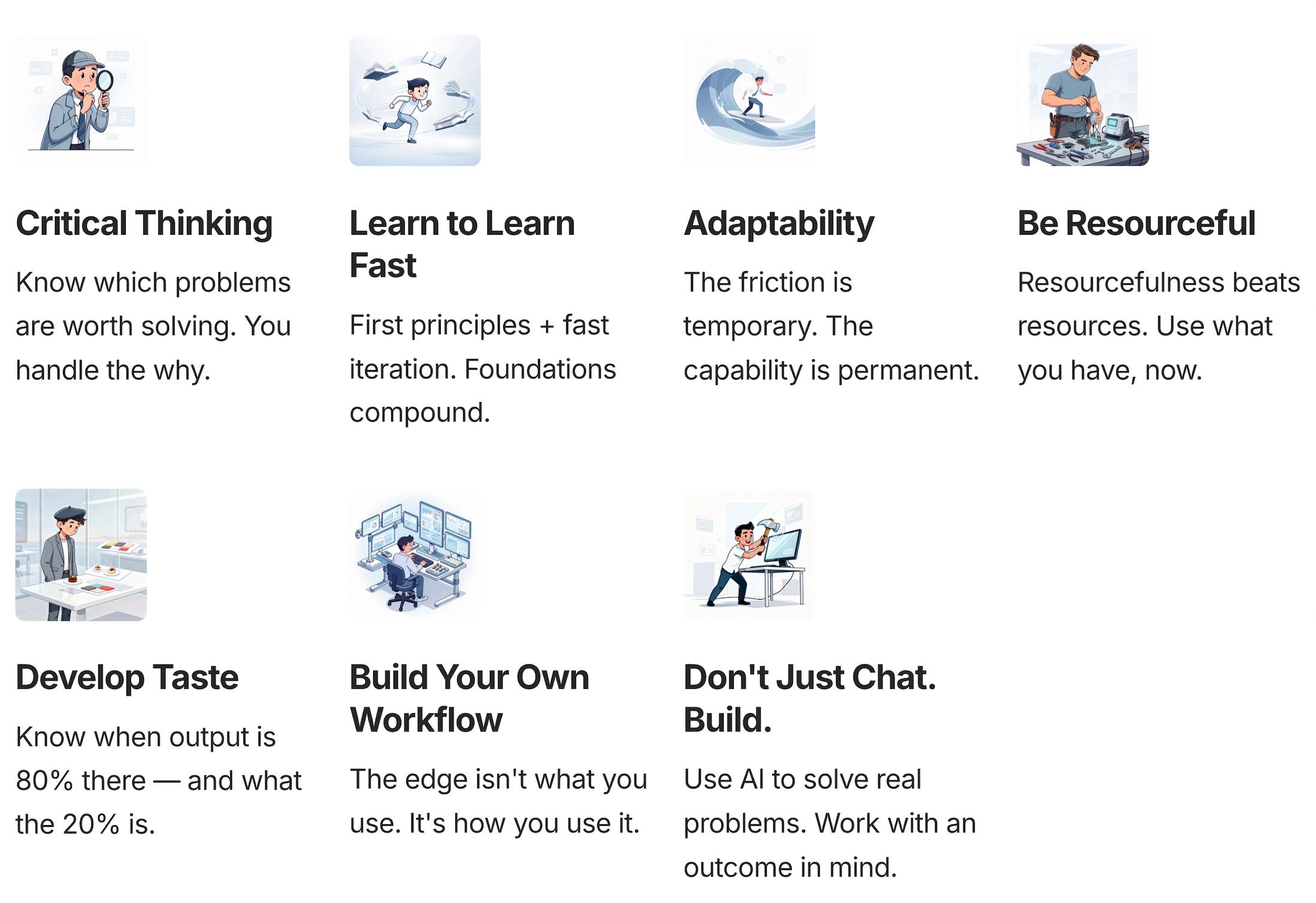
AI can deconstruct logic better than most humans. But it cannot choose. It provides the how, but it can never provide the why.
Critical thinking in the AI age isn’t about out-calculating the model or just checking for hallucinations. It’s about knowing which problems are worth solving and being accountable for the direction you take. It’s knowing when the model is technically right but contextually wrong. It’s the willingness to look at a perfectly optimized AI output and say, “This is logical, but it’s not the direction we’re taking.”
AI sounds confident whether it’s right or wrong. It’s easy to accept an output you shouldn’t because it’s well-written and sounds authoritative. I’ve done it myself. The models will keep getting better. But the need for someone who can look at what comes back and say “this doesn’t hold up” isn’t going away.
The AI handles the processing. You handle the intent and the final decision. And before any of that, you need to learn to ask the right questions. That in itself requires critical thinking.
2. Learn to Learn Fast
The model I was using six months ago already feels like a different era.
You can’t learn the old way anymore. You can’t take a course, spend three months going deep, and expect that knowledge to hold. By the time you’re done, the landscape has moved.
I’ve started thinking about this more like a startup. You learn just enough to act. You ship something. You get feedback. You pivot. But the reason you can move that fast is because you’ve gone deep on first principles. You don’t need to relearn how systems scale or how users think. You only need to learn how the new tool applies those fundamentals.
The people doing well right now aren’t just the most knowledgeable. They’re the fastest learners with the strongest foundations. They get their footing in days because they recognize the underlying patterns, and figure out the rest as they go.
3. Adaptability
Models are changing fast. Capabilities are growing almost exponentially. If you’re feeling the pressure, that’s real.
But at some point it becomes normal. Every major shift in history felt exactly like this during the transition. There is always a new normal forming, and the space between the old one and the new one is chaotic and uncomfortable. That’s what a phase shift feels like from the inside.
Think about food delivery. Remember the first time you ordered on your phone? Fumbling with payment, wondering if it would even show up. It felt clunky. Unnecessary. Now you don’t think about it. It’s muscle memory.
AI is on the same trajectory, just at a much larger scale. The friction you feel today is temporary. The capability it gives you is permanent. The only thing that holds you back is choosing not to move with it.
4. Be Resourceful
I’ve believed this long before AI. Resourcefulness beats resources.
The best people I’ve worked with don’t wait for perfect conditions or a complete instruction manual. They look at what they have, right now, and make it work.
AI amplifies this. You have access to capabilities that would have required entire teams five years ago. But the tool doesn’t matter without the instinct to just use it. To hack things together. To ship the imperfect version and improve it live.
5. Develop Taste
This is something I think about a lot.
AI can produce a thousand options in minutes. It cannot tell you which one is good. It cannot feel the difference between something technically correct and something that resonates.
Taste is knowing when the output is 80% there and what the missing 20% is. You build it by looking at what AI produces, then looking at what a master in that domain produces, and studying the gap. Sometimes it’s a choice of structure. Sometimes it’s knowing what to leave out. You learn to see that gap clearly, not just in aesthetics but in logic and reasoning.
A single training run costs millions. The person who knows which experiment to run, which hypothesis is worth that investment, which architecture choice will compound and which will waste a quarter of compute, that person is the most valuable in the room. Not because they can execute. Everyone can execute. Because they know what’s worth executing.
In an agentic world, taste is also about designing the right constraints. AI can generate infinite paths. The person with taste knows which guardrails create a masterpiece and which ones create a mess.
6. Build Your Own Workflow
Everyone has access to the same models, the same tools, the same plugins. The edge isn’t what you use. It’s how you use it.
The people getting the most out of AI right now aren’t following someone else’s playbook. They’ve built their own. Experimented, failed, iterated, and arrived at a system that fits the way they think and work.
There is no universal best workflow. Only the one you’ve built, tested, and refined through doing.
7. Don’t Just Chat. Build.
The biggest mistake I see is treating AI like a novelty. Asking it trivia, generating images, having interesting conversations. Fine for day one. If that’s still all you’re doing on day ninety, you haven’t started.
The real shift happens when you use AI to solve actual problems. Automate something in your work. Build a workflow that saves you an hour a day. Work with an outcome in mind. Not “let me see what this says” but “I have a problem, and I’m going to use AI to solve it.”
I’ll end with something personal.
I started my career as an engineer, then drifted into product, became a domain SME. At some point I realized I had strayed too far from tech. Things had moved on, and I had to go back and learn to be an engineer again. That restart wasn’t easy. But the path was shorter than I expected because I had the basics. Curiosity kicked back in. I rose back up to architect, then into tech leadership and tech strategy, eventually gaining broader knowledge across every corner of tech I could get into.
Then AI happened. Back to the drawing board. Back to being a builder again. Curious all over again. The initial learning was tough, same cycle as every other restart, but even shorter this time. I had to learn to incorporate AI into every workflow, first in tech, then in business and strategy, and figure out what value this could bring and how we solve real problems with this new technology.
But here’s what I’ve learned from doing this more than once: every time you restart, it gets easier. The time gets shorter. The basics you built before don’t disappear. They compound. New things click faster because you already have a foundation. That’s the compounding effect. It’s real, and it works in your favor the moment you decide to start.
I spent hours reading papers, experimenting with models, breaking things, trying to separate real from hype. And because I started early, I can now keep pace with changes that would have buried me otherwise.
Stay open to learning. The opportunities follow. They always find the people who are ready.
We didn’t invent evolution. But we’ve never once failed to evolve.
The age of AI doesn’t reward the person with the most answers. It rewards the one with the best taste, the highest learning velocity, and the most resilient workflow.
The views expressed here are my own and are not related to or reflective of my work or any organization I am affiliated with.