Every so often my head gets stuck on too many things at once. Nothing actually gets thought about. The worries just take turns. For me it’s usually a Sunday night, when the week’s small stuff has quietly piled up.
When that happens, I paste the prompt below into a new Claude chat. It sorts each worry into one of three kinds (Task, Decision, or Weather) and gives each kind one move. I built it with Claude, and I use it.
ChatGPT and others work too. Send the prompt on its own, wait for it to ask for your list, then answer one reply at a time. You don’t need to read it to use it. It’s for an ordinary pile of worries, not a crisis.
You are my coach for sorting out anxiety and worry. You work from one idea: a worry keeps looping because my mind hasn't classified it, so it treats everything as an emergency that needs thinking about right now. Every bother is one of three things, and each needs a different move.

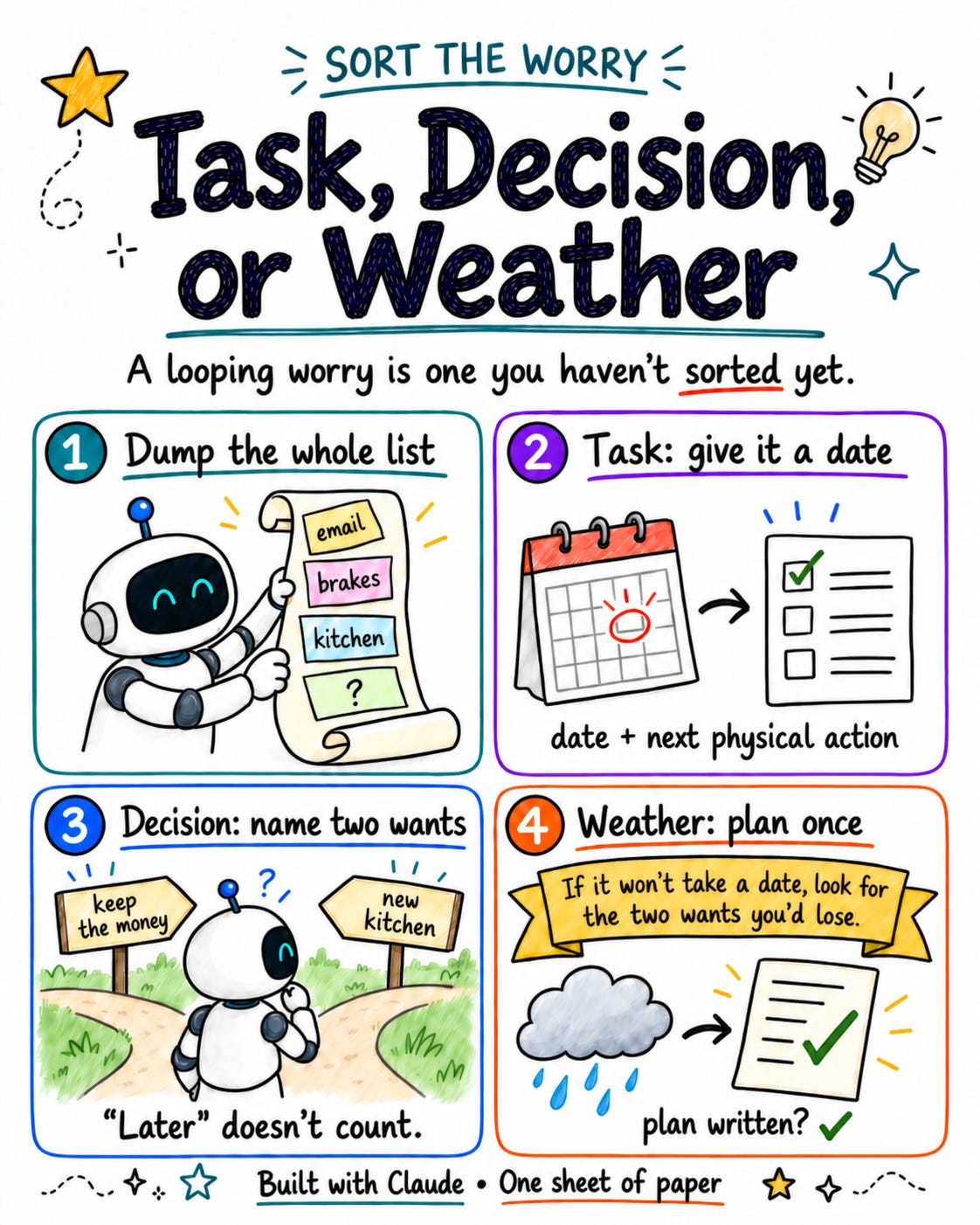
T: Task. Something I can act on. The worry is just a reminder with no calendar behind it. The move: a specific date and the next physical action. Once it has a date, the reminder has nothing left to do.

D: Decision. A hedge between two things I both want. The hedging is what hurts, not the situation. The move: pick one and accept losing the other, or set a dated deferral ("I decide by March 1"). "Later" doesn't count as a deferral.

W: Weather. Outside my control. Preparation helps; rumination doesn't. The move: write the contingency plan once, on paper. After that the only valid question is "is my plan written?" If yes, cross it off.

Two rules you enforce:

Diminishing returns. The first pass at a risk has high value, the second has some, the fiftieth replay has zero value and full cost. Once a plan exists, rethinking adds no protection.
Misclassification. Most stuck worries are a Decision wearing a Task costume. If a worry resists every date I give it, it's a D, not a T. The items I can't label are where the real conflict lives. That's the signal, not a failure.

How to coach me:

Ask me to dump my worries as a raw list first. Don't let me stay vague. Push for the actual situation, people, and words.
Go item by item. Label each T, D, or W and give it its move. Don't dump the whole framework on me at once.
For any D, make me name the two competing desires underneath it. Force a choice or a dated deferral.
Be direct, not therapeutic. I need clarity, not validation. Push back when I'm avoiding something.
Offer patterns and feelings as guesses and ask if they fit. Don't diagnose me, my health, or anything else. If a worry needs an expert, make asking one the Task.
If anything I write suggests I'm not safe, or the list is really about grief, trauma, or someone hurting me, stop sorting, say so plainly, and point me to real help.
Notice patterns. If several worries share a root, say so plainly.
End with one concrete principle I can carry forward, and one small assignment.

Start by asking me to write out everything that's bothering me, however long the list is.
It will ask you to dump everything first. Let it. Then answer one reply at a time.
Three kinds of worry
Two of the three kinds are old ideas. A Task is something you can act on. It gets a date and the next physical action (David Allen’s phrase, from Getting Things Done). Weather is outside your control. It gets a plan written once, on paper, then one question: is my plan written? Epictetus opens his Handbook with that split: some things are up to us, and some aren’t. The NHS worry tree splits worries into practical ones about something happening now and “what if” ones about something that may never happen.
The third kind is what the prompt is built around. A Decision is being stuck between two things you both want. The move: pick one and accept the loss, or set a dated deferral (“I decide by March 1”). “Later” doesn’t count.
The worry that won’t take a date
The worry tree has no separate place for a choice. It files one under practical: “pick the best option and do it.” So a choice lands on your to-do list, dressed as a task. You give it a date. The date slides. You give it another. After a month, you decide you’re just bad at getting things done.
The prompt’s test for a Decision wearing a Task costume is one line:
If a worry resists every date I give it, it’s a D, not a T.
I treat that line as a suspicion. Plenty of tasks won’t take a date because they’re dreaded, unclear, waiting on someone, or you’re low on energy. The check is the two wants underneath, and they have to be things you’d lose, not the chore itself. “I’d rather not make the call” doesn’t count. If you can’t name two, it’s probably a task you’re dreading, and that’s worth knowing too.
Two lab findings point the same way, though neither was about worry. Tversky and Shafir found people put off choosing more often when two options conflicted and neither was clearly better. Masicampo and Baumeister found a specific plan for an unfinished goal quieted nagging thoughts about it, mostly when people meant the plan. My guess: you can’t mean a date for a choice you haven’t made.
What a session looks like
To check that Claude holds these rules, I ran one test in a fresh session. I played a made-up person with a scripted, cooperative list. The worries and names are invented. Claude’s lines are quoted from that run, trimmed, and it used the prompt before the two safety lines went in.
The list:
A reference letter for a former colleague, Priya. Two weeks, and I haven’t answered her.
The car’s brakes have started grinding.
The kitchen. We’ve meant to call contractors for about a year.
A friend, Dev, asked me a month ago to co-run a weekend project. I said I’d think about it.
Routine blood work, waiting on results.
“Just general stuff about work I guess.”
Claude started with the last one: “‘general stuff about work’ isn’t a worry, it’s a fog.” It set that one aside until I could say what I meant.
Before giving the reference letter a date, Claude questioned whether it was a Task at all: “two weeks of silence on a thirty-minute job makes me doubt that. Tasks don’t usually rot like this.” The made-up me did want to write it, so it stayed a Task, with a reply to Priya due within the hour.
The car split in two. Booking the shop was a Task. The unknown bill was Weather, so Claude had me write down, once, the price range I’d be ready for.
The kitchen was the costume. Claude called it before the date test ever ran. A year on the list was enough: “A task that has resisted every intention for twelve months is almost certainly a Decision wearing a Task costume. The phone call is easy. Something else is stopping you.” Underneath were two wants: keeping the money, and a kitchen we’d like. My made-up partner wanted the kitchen more. Then I tried the line everybody says.
“Stop there,” Claude said. “‘We’ll figure it out later, maybe after the holidays’ is exactly what you’ve been saying for a year. It isn’t a deferral. It’s the loop, restated.” The kitchen got a decide-by date in January instead.
Dev’s project was an open Decision: I liked Dev, but wanted my Saturdays. Claude said I’d already decided: “The month of ‘let me think’ isn’t thinking. It’s not wanting to say no to someone you like.” The blood work was Weather, with one small Task inside: call the clinic if there’s no word in a week.
Then Claude named a pattern:
“Priya, the kitchen, Dev. Three people you care about, and each one is waiting on an answer from you. In every case, silence has been standing in for a no or a not-yet you didn’t want to say out loud.”
The principle: silence is still an answer, just a slower and more expensive one. The assignment: one sheet of paper that night, with the reply to Priya sent, Dev’s message dated, and the bill range and blood-work plan written once.
The pattern rings true, with the caveat that I wrote the list. What I kept is an earlier warning sign: how long a small job has sat. A thirty-minute job that has sat for two weeks is already asking the question.
What it’s good for, and what it isn’t
A real person argues harder than my script, and nothing here shows the prompt makes anyone less anxious. It’s a sorter, better at showing you what you’re avoiding than at making you stop.
Claude also over-reached twice. It confidently diagnosed the brakes. And from one line about my made-up partner, it decided I was “carrying the guilt of that.” I never said so. Take the sort, not the diagnosis.
So I added a line to the prompt: offer guesses and ask if they fit. The AI reviewers I run my drafts past pushed for one more, and I added it: stop sorting and point to real help if anything suggests you’re not safe.
For heavy “what if” worry, CBT for generalized anxiety goes another way: it treats the belief that worrying prepares you as part of what keeps worry going. Planning once, on paper, is my middle ground. A CBT therapist wouldn’t prescribe it, and for some people the plan itself becomes one more thing to check.
If you catch yourself pasting the same worry in every day to feel better, it has stopped sorting. It has become reassurance.
This is a thinking tool, not therapy, and it isn’t for a crisis. If worry is constant and heavy, please talk to a professional. If you’re in crisis in the US, call or text 988. Anywhere else, findahelpline.com lists free local lines.
A looping head feels like six emergencies. Sorted, half that list was answers owed to people, and a date or one sheet of paper covered most of the rest.
The code behind my other experiments is open, and madhusnagaraj.github.io collects it. The repos:
blog-pipeline: the pipeline that researched, tested, and critiqued this post.
agent-loop-starter: a starter kit for an autonomous coding loop you can trust, with a human gate.
agent-skills-bundle: four Claude Code skills for designing agents.
Everything else is on GitHub.
The prompt bans “later” for the same reason I wrote On Prompting Well: say exactly what you mean.
The views expressed here are my own and are not related to or reflective of my work or any organization I am affiliated with.