I missed something that mattered to someone I care about because I forgot to put it on the calendar.
It was in a text message. I was heads-down on something else. By the time I remembered, it was too late. You know the feeling. It stays with you.
I didn’t have a system. I had intentions. I had apps. I had to-do lists I reorganized every Sunday, a ritual that made me feel productive without actually making me productive.
I’ve been using AI for a long time. When agentic AI started becoming real, I started using it as a thinking partner for research, planning, working through ideas. That changed how I think. It brought clarity to how I approach problems. I’m still figuring things out, but the trajectory is clear.
Over time I layered more on. A weekend coaching ritual. A research workflow. Each started as an experiment. Each stuck because it solved something real.
Then last week I connected NanoClaw, a lightweight open-source personal AI agent, to a Google Calendar MCP server. Set it up on a Mac Mini. Named the agent Jarvis. Now my family schedules appointments by messaging WhatsApp.
I used Claude Code to set up NanoClaw. An AI agent helped me configure another AI agent. The system was proving the thesis before it was even running.
That’s when something shifted. I wasn’t reaching for AI anymore. I was surrounded by it. Calendar, briefings, research, coaching, planning, all running through interfaces I already use every day. WhatsApp for family. Slack for reading what AI prepares for me. Google Tasks for what needs to get done.
I’ve started calling it the agentic mindset. Not using AI as a tool you pick up. Living with AI as a partner that’s always running.
I get curious about things. How multi-agent systems actually work. Whether the premise that specialized agents outperform a single generalist holds up in practice. How orchestration patterns from a research paper translate into real code.
This used to come with a cost. Fifteen tabs open. A paper too dense to finish. Jargon that loses me by page three. I have a bookmarks folder called “Read Later” with over 200 links in it. I’ve read maybe twelve.
The cost of exploring was high enough that I mostly didn’t. Which means I was operating on what I already knew, not what I could know.
Here’s a specific example. I found a paper on arXiv called “The Orchestration of Multi-Agent Systems.” Dense, academic, full of formal notation. Old me would have bookmarked it and moved on. Instead, I dropped it into an AI conversation and asked for a structured breakdown: what’s the core framework, what are the seven orchestration responsibilities, and what would it take to build this.
AI broke it down in minutes. I understood the architecture. Then I built it. Three agents, a deterministic orchestrator, real flight data. 1,500 lines of Python. I raced the multi-agent system against a single agent across three cities and found that multi-agent only wins when the search space is large enough that focused attention finds what divided attention misses. I published the whole thing on my Substack.
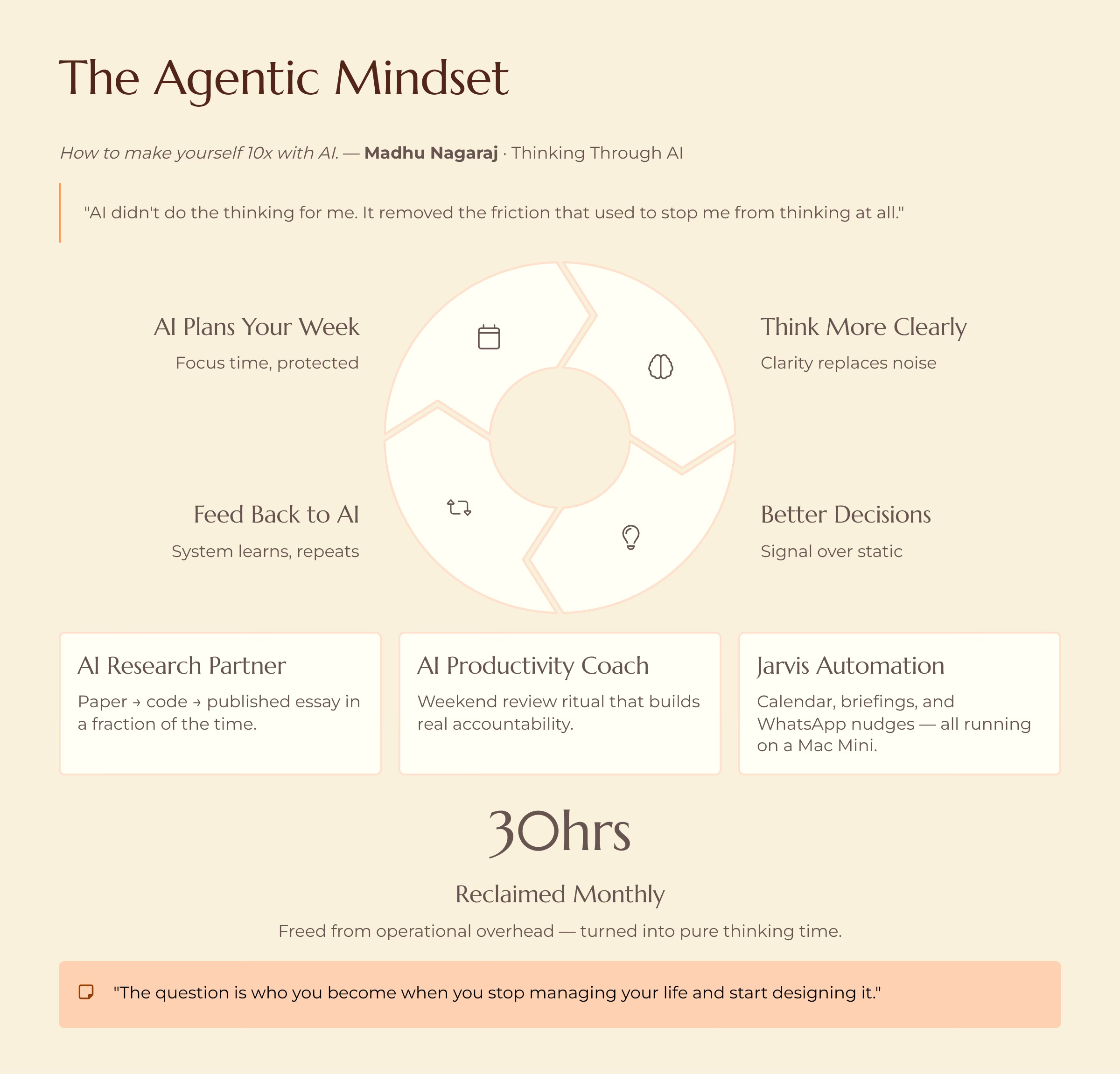
The arc from “interesting paper” to “working code” to “published essay” happened in a fraction of the time it would have taken before. That’s the shift. AI didn’t do the thinking for me. It removed the friction that used to stop me from thinking at all.
I have tried every productivity system. GTD. The 3-2-1 method. Time blocking. Pomodoro. Bullet journals. Each one works for a week, maybe two, then falls off. Not because the method is bad. Because there’s no one on the other side keeping me honest.
So I built an AI coach. I gave it my weekends.
Every weekend, twenty minutes. What got done around the house, what I promised my family, what I kept putting off for myself. The side project I said I’d start. The reading I never got to. The errand that’s been on the list for three weeks. Then we plan the next week around what actually matters to the people in my life, including me. It doesn’t list my tasks. It challenges me.
“You said you’d start that project three weekends ago. What’s actually stopping you?”
“You have a free Saturday morning. Are you protecting it or letting it fill up?”
“Is this actually important to you or are you avoiding the harder thing?”
By Sunday evening I’ve already thought about the week. I know what matters. I start Monday in motion, not scrambling.
I used to miss appointments because every one required a context switch. Leave WhatsApp, open the calendar app, type the details, go back. The real cost was never the thirty seconds. It was that my brain left whatever I was doing. Every time I thought “I’ll add that later,” it became one more thing occupying mental RAM.
Now I message Jarvis on WhatsApp. “There’s an appointment on April 14 at Chandler. Add that to the family calendar.” Jarvis confirms, adds it, asks if I know the time. Done. My brain never leaves the conversation.
My whole family uses the same system. Anyone can message Jarvis, ask what’s happening this weekend, add something. One shared calendar. No bottleneck.
Jarvis also nudges. Tax filing deadline coming up? “April 15 is 13 days away, have you carved out time to file yet?” I didn’t ask for that. Jarvis knew it mattered.
Every morning, Jarvis drops a news summary into WhatsApp. Three to five items. This morning: a cybersecurity model finding thousands of zero-day vulnerabilities, a major revenue milestone at Anthropic, Google releasing a new open-source model. Two minutes to read. Caught up before my coffee was done.
These pieces feed each other. That’s the part I didn’t expect.
The weekend coaching review looks at my Google Tasks and calendar, finds the open gaps where real thinking can happen, and helps me protect them before the week fills up. The briefings keep me informed without consuming my morning. The research partner accelerates my learning without the tab-explosion. The calendar handles the logistics without the context switching.
None of this is about getting more done. It’s about creating space to think.
During a recent weekend review, my AI coach pointed out that I’d committed to writing three times in the past month but only followed through once. I hadn’t noticed the pattern. I thought I was busy each time. But seeing it laid out, three commitments, one delivery, I realized I wasn’t protecting time for writing. I was hoping time would appear. The next week I blocked two hours on Sunday morning before anything else. That’s where this essay came from.
Before all of this, I spent roughly an hour a day on operational overhead: scrolling for news, managing calendars, reorganizing task lists, trying to remember what I was supposed to focus on. Now that’s down to minutes. The hour didn’t disappear. It turned into thinking time. Over a month, that’s thirty hours back. Not for more tasks. For clarity.
Since I started, Jarvis has quietly grown. (The name is a cliché, I know. But when your family already calls it Jarvis, you stop fighting it.) It reads photos now, so my family can send receipts and they land in Notion automatically. It transcribes voice notes locally, so the kids can talk to it without typing. It runs a small local model alongside Claude for the cheap tasks, which cut my costs without cutting quality. And last week I added something that still surprises me: a meta-tool that lets Jarvis build its own tools on the fly. When someone asks for something it can’t do yet, a weather lookup, a currency conversion, it finds an API, writes itself a tool, tests it, and uses it. Next time anyone asks, the tool is already there. I didn’t build any of those capabilities. Jarvis did.
It also breaks. The meta-tool once hallucinated an API endpoint that didn’t exist, built a tool around it, and confidently returned wrong weather data for a week before anyone noticed. A container crashed mid-calendar sync and duplicated every event for a Tuesday. The plumbing I described earlier isn’t a one-time cost. It’s ongoing. Things fail, and when they fail quietly, you don’t find out until someone shows up to the wrong appointment.
That’s the honest version of “it keeps building itself.” It keeps building itself, and sometimes it builds the wrong thing. The system is not finished. I’m not sure it ever will be. That might be the point.
A few things I want to be honest about.
The plumbing took grit. WhatsApp API configuration, MCP server setup, container permissions. If you’re comfortable in a terminal, the barrier is surprisingly low for what you get back. If you’re not, this is a weekend project with some frustration built in.
NanoClaw runs on the Claude Agent SDK, so there’s a dependency on Anthropic. The codebase is small enough to adapt, and people have swapped in other models, but I want to be straightforward about that.
It’s not free. API calls cost money. But there’s no monthly subscription to a platform that owns your workflows. The cost scales with usage, and the system is yours to modify.
The agent logic runs on my home hardware. My Mac Mini, my house. It connects to services I already use and trust: Google Calendar, WhatsApp, Claude’s API. There’s no additional third-party collecting my family’s data in between. I chose the services. I control the wiring. In 2026, there’s a particular peace of mind in knowing your family’s WhatsApp messages aren’t sitting in some startup’s database, training the next model.
Everything I’ve described here, I figured out for myself. One person. My own friction points.
What I keep thinking about is what happens when more people operate this way. The same patterns, briefings, coaching, removing friction, applied beyond one person. The implications are massive. I’ll write more about that.
If you want to start without building anything: every Saturday or Sunday, spend twenty minutes with any AI reviewing your week. What you planned, what actually happened, what you’re carrying forward. Do this for four weekends. The pattern recognition alone will change how you operate.
I started by missing something that mattered. I ended up rethinking how I learn, how I stay focused, and how I spend my days.
The question isn’t whether AI can do this. It can. Today.
The question is who you become when you stop managing your life and start designing it.
The views expressed here are my own and are not related to or reflective of my work or any organization I am affiliated with.