The views expressed here are my own and are not related to or reflective of my work or any organization I am affiliated with.
I stopped opening my money app about a quarter ago.
Not on purpose, at first. I just noticed one day that I hadn’t checked it in weeks, and nothing had gone wrong. Something else was watching it now, and it told me only when I actually needed to know.
Since the beginning of the year I set up a handful of AI agents to carry parts of my life. What surprised me wasn’t the time it saved. It was how much lighter my head got.
I didn’t build some grand system. I set up an assistant I can text, connected it to a few of my tools, gave it enough of my context to be useful, and described what I wanted in plain sentences. Some of it works really well. Some of it is new and a little rough. I’ll tell you both.
The setup, in a few sentences
I have an assistant that’s always on. I can text it like a person. It’s connected to some of the tools I already use, and it holds a memory of my context, the stuff I’d otherwise have to re-explain every time. On top of that, I can schedule little routines in plain English, almost never touching code.
It doesn’t all run in one place:
Some routines run as scheduled tasks inside Claude’s Cowork, which can open my apps and work with my files directly.
Others run on the always-on agent itself. In the first post that was Jarvis, running on NanoClaw. I’ve since replaced it with Hermes, an open-source agent doing the same job, still on the same Mac Mini in the corner.
Keeping it on that Mac Mini, in a container, off my everyday laptop, is deliberate. So is what I plug into it: a secondary email and its to-dos, a shared calendar, a private repo, my notes. Not my primary accounts, and not everything I do. It reaches a small, deliberately chosen slice of my world.
The real friction is right there. Getting something on that machine to reliably talk to my calendar and mail up in the cloud is most of the actual work.
Finance
This is the one that weighed on me most, so I set it up first: a folder with my financial data, a short note explaining my budget the way I’d explain it to a friend, and a set of little routines that quietly grew to almost ten before I looked up.
Here’s the part I glossed over the first time, because it isn’t magic. The morning summary comes from a routine that opens my finance app and clicks through it the way I would: sync the accounts, tidy the categories, export the numbers to a file, then write me two or three plain lines. Around it: an evening flag if something looks off, a weekly review that just shows up, a cash-flow look-ahead so a bill on an awkward week stops being a surprise. At one point I had it pulling market and holdings research off the web every week too, a plain read-only digest I could glance at and never had to act on.
I won’t pretend that’s clean. Driving an app by clicking through it is brittle, and it breaks the moment the app logs out or moves a button. And the model does see the real thing while it works: the actual screen, real numbers and names. But the app is only an aggregator, a read-only mirror of my accounts. It holds transactions and nothing else, and no real account can be moved or operated through it. The worst it can do is read back a list of what I already spent. It can’t touch a cent.
And I should be honest about how it actually goes, not just how I set it up. It ran like clockwork through the spring, and for those months the change was real: money used to sit at the edge of my attention all day, the low hum of not-knowing, and that mostly went quiet. Then I stopped tending it, and the briefings have thinned out these last few weeks. There’s clutter in there I never cleaned up, a couple of near-identical routines, one just named “Check.” That’s the honest shape of it: real relief while I tended it, and the first corner to go quiet when I didn’t.
Time
The assistant triages my inbox and reads my calendar, and a few routines keep me current on my field so I stay up to date without refreshing anything myself.
There’s a set of small mental tabs most of us keep open. Did I reply to that. What’s on tomorrow. Did I miss anything. Not hard, just always there, quietly taxing your attention.
A lot of those tabs closed. I’m more present at dinner, not because an agent made dinner, but because the part of my head that used to be half-doing-admin got handed off.
The honest note here is a little funny. For a long time, every routine I’d built watched my field: new models, new papers, every thirty minutes. Not one of them watched me. Nothing ever asked how I slept. That’s what got me to the next part.
Health
So I set up a few routines aimed at me for a change.
An evening check-in that asks, once, whether I moved. If I already logged something, it says nothing.
A Sunday meal plan that drafts the week and a grocery list from the foods I like.
A morning sleep read meant to turn last night into two plain lines: push, ease off, or rest. That one runs on schedule, but the sleep read isn’t reliable enough that I trust it yet.
I set all three up by texting the assistant in plain English. Adding a whole new corner of my life cost about a paragraph, because the schedule, the memory, and the rule about not pestering me were already there.
This is the part I’m quietly proud of. For the first time, something in my setup is pointed at me, and not just my work.
Learning
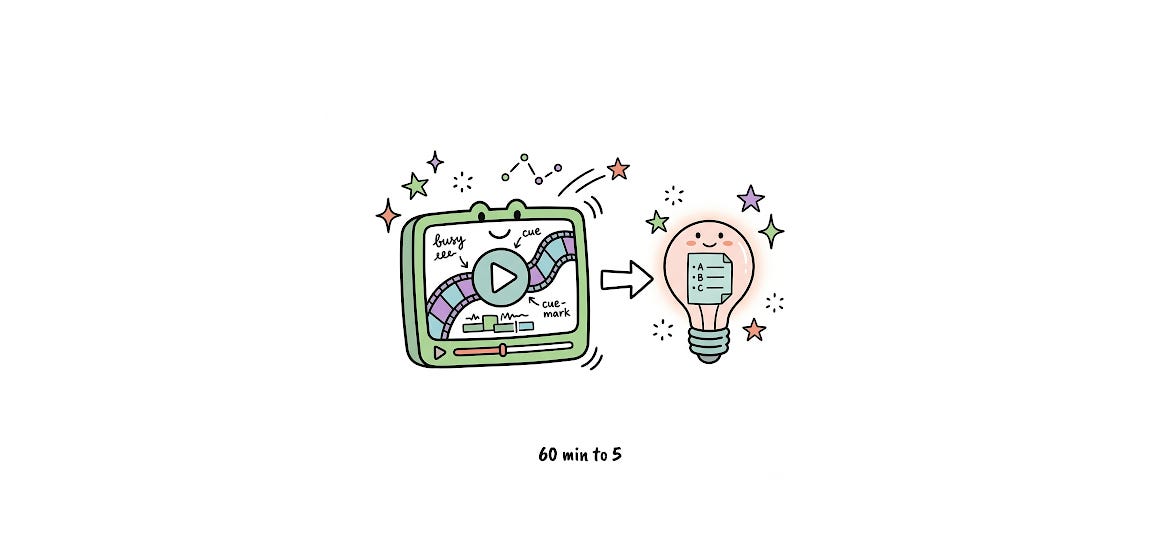
Learning is where the setup changed me the most.
The trick everyone already knows is the boring part: I turn an hour-long talk into a five-minute read by pulling the transcript and having the assistant strip it to the actual argument. That saves time. It isn’t the interesting part.
The interesting part is what happens to what I learn. The compressed version gets written out as a plain note and dropped into a personal Obsidian wiki, linked to whatever it connects to. That wiki has quietly grown into a real second brain: a widening web of small notes I can navigate and build on. Learn a thing once, reach it forever.
There’s a second, sneakier trick. I keep a running list of things to write about, mostly short posts on tools that just launched. I can’t write about a new thing without understanding it first, so the post quietly becomes a deadline to learn.
The line I won’t cross: the assistant does the compressing, but the understanding is still mine to build. Generation got cheap. Understanding didn’t, and I’m glad it didn’t.
The one idea underneath all of it
I described the money, and it got handled. I described my time, and the admin lifted. I described a check-in, and my health got some attention. I described the way I wanted to learn, and it got faster.
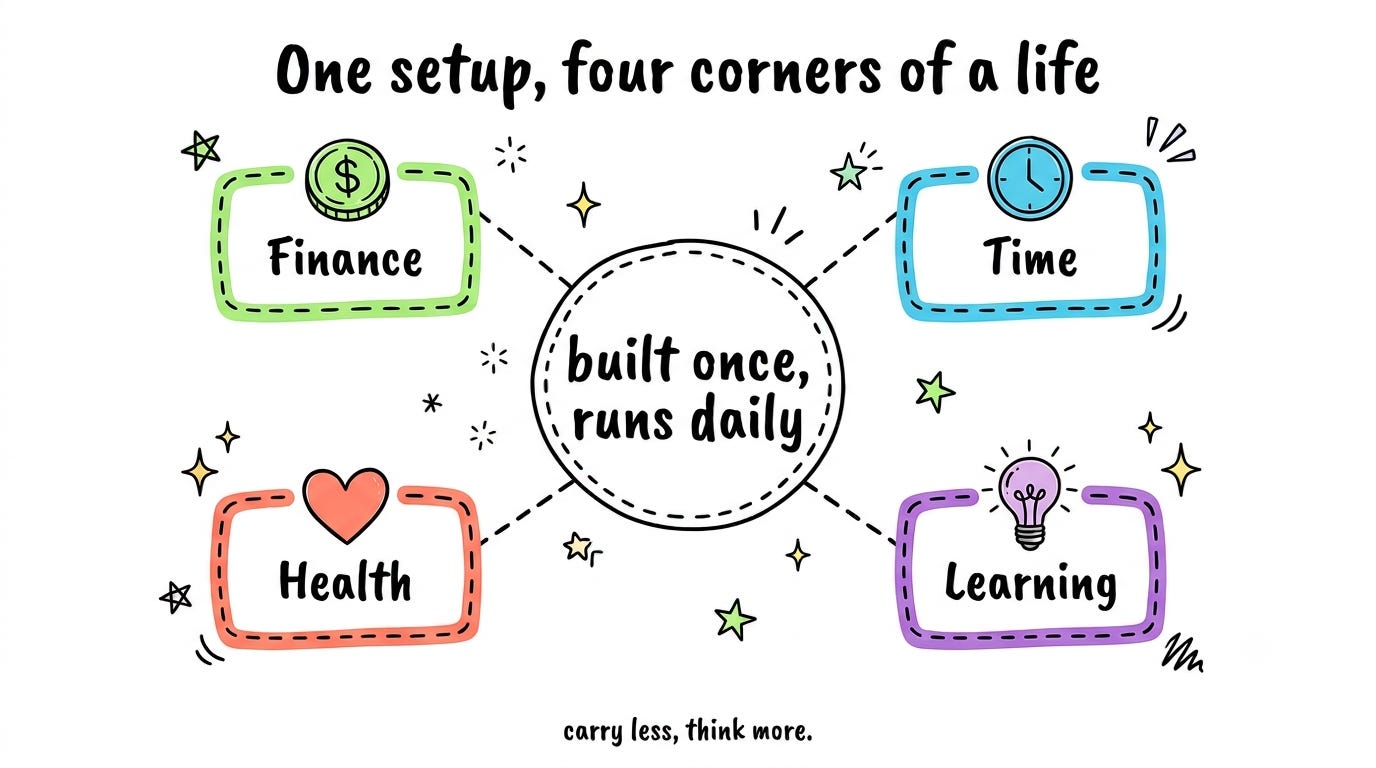
Four corners of my life, and the same small move worked in every one. You don’t build a big system. You describe what you want clearly, once, and let a connected setup do it.
It’s not magic, and not all of it is still humming. The honest split is this: the always-on assistant kept running on its own, its daily and weekly routines firing whether I checked in or not. The finance side, the part I have to tend, is the part that drifted, the way routines do when an app logs out and nobody notices. What runs itself keeps running. What needs tending rots wherever I stop paying attention.
But the win is ordinary, and that’s the point. I didn’t get a bigger life out of this. I got a lighter one. Less carried in my own head, a little more of me left over for the parts I actually wanted to be present for.
I want to spend that room thinking and understanding, because that part is still mine. If anything survives this wave of new tools, I think it’s that: the judgment and the understanding underneath, not the doing. That’s the whole point of it. Not doing more. Thinking more, and carrying less.
This is a sequel to The Agentic Mindset. That post was the ambition: the always-on Jarvis and the big promise. This is the quieter, truer version of it a year on, the parts that actually stuck, and the ones I’m still honest were rough.