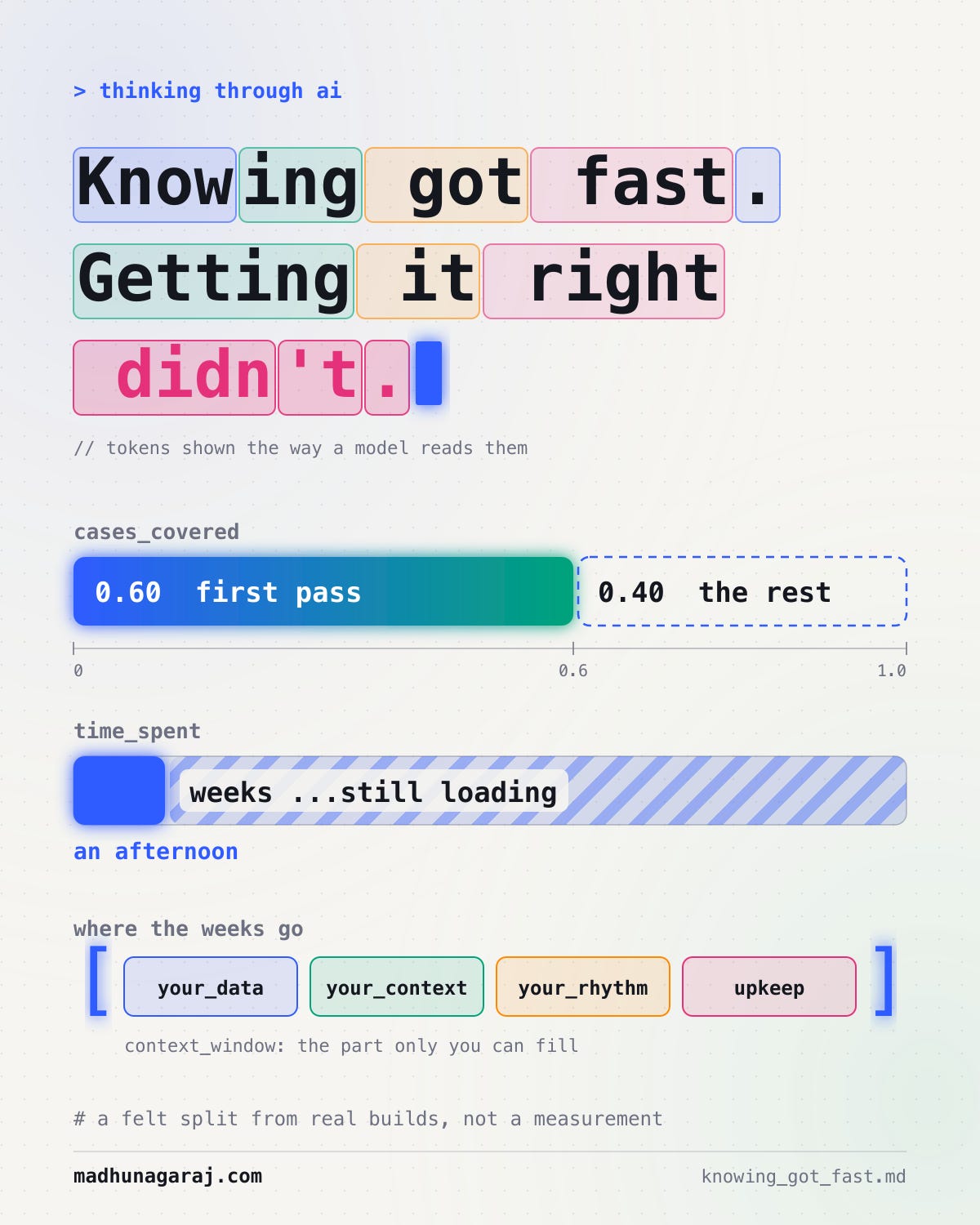
Knowing got fast, and starting got nearly free. Getting it right did not get faster, and the ground keeps moving under whatever you build on it.
The rest of this is where that view came from, and the frame of mind I would hand anyone who wants to use AI without first betting on a forecast.
What it brings is real
Learning, analysis and insight are closer to ordinary people, and to companies, than they have ever been. What used to be buried in books or locked behind a specialist now arrives as a conversation you can question until you understand. What took months to automate now takes days.
Outside work, the changes can be bigger. Someone writing in a second language no longer pays twice for every sentence, once to think it and once to render it. Someone facing a dealer or a contractor can’t match what they know, but can now process it closer to their speed. Neither is a productivity story. Each is a wall coming down for one person.
What it doesn’t bring is your groundwork
The automation I grew up building was predictable. You wrote the rules, and it did exactly what they said, right or wrong. AI handles most of the cases quickly, then stops being right in ways that look exactly like being right.
If I had to put a split on it, the first 60% comes almost free and the last 40% is where the time goes. That is a feeling from my own builds, not a measurement, but careful research points the same direction: when Humlum and Vestergaard followed Danish workers using chatbots, workers reported time savings of about 3%, and some reported new tasks the tools created, from drafting to integration and oversight.
The 40% depends on things the model doesn’t bring: your data, your context, your rhythm.
Personal finance shows it well. Point an AI at a spending export and you can have dashboards by the end of the afternoon. Within days the folder fills with files named “CORRECTED”, “FULLY_RECONCILED” and “True_Spending”. The model was ready on day one. The data and the context weren’t.
A large drop in an investment account reads as a market loss. It was money moved out to buy something else. The analysis is fluent, confident and wrong, because without context, moving money looks exactly like losing money.
So the work moves. You rebuild history from statements, tag every number with its source, and let scripts do the arithmetic. The context goes into files too: a decision log so settled debates stay settled, a “where I left off” note and a list of unanswered questions so each session starts where the last one stopped. Getting this month right takes days. Getting the years behind it right takes weeks.
AI made the analysis cheap. It made curating context the job.
Most advice about living with AI is about judgment: keep a human in the loop. I agree, and I have written a version of it myself. But judgment isn’t what runs short first. What runs short is groundwork only you can lay, and the patience to keep it current.
The ground keeps moving
Even when you get it right, it doesn’t stay right.
Workflows need reimagining, not speeding up. In software, requirements, design, testing and review all assumed the tools would hold still long enough to plan around. They don’t. Planning becomes just-in-time, and the real skill is finding the part that will still matter in a few years.
Maintenance is the cost nobody budgets for. In one agent experiment this month, a model missed the same case, a contract that had ended but was still being billed, in two of four runs. The next day a newer version of the model shipped, and I moved the agent to a hosted runtime at the same time. It caught the case in both runs that followed. Two runs aren’t enough to call it reliable, and I couldn’t isolate which change helped. I only know this much because the test was written down and could be run again. Every upgrade buys you a re-test.
Some of what you build is a crutch. Scaffolding for a model’s weak spots keeps moving into the models, so part of the upkeep is deleting your own work. And the menu changes: not just better models but new kinds, like ones that return a decision instead of a paragraph. Yesterday’s sensible choice can be the wrong one next quarter.
Think in outcomes, not tools
If the tools keep changing, anchor on the outcome. Tools turn over every few months. The outcomes you want from them change far more slowly.
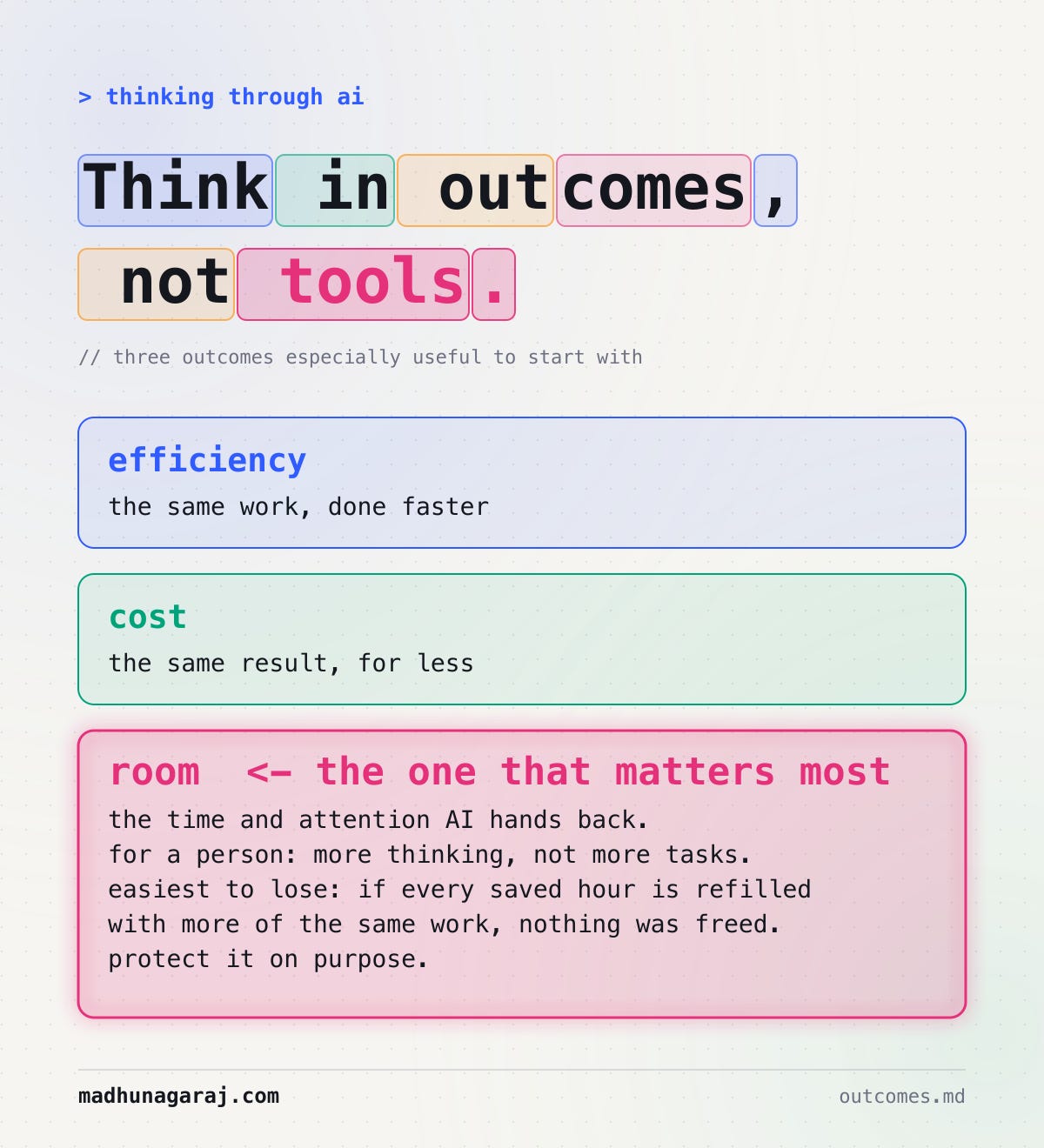
The outcome I would start with is room: the time and attention AI hands back. For a person, room means more thinking, not more tasks crammed into the same day: the question you never had time to ask, the thing you would learn if the busywork were gone. It is also the easiest outcome to lose. If every hour AI saves is refilled at once with more of the same work, nothing was freed. Protecting it is a choice you make on purpose.
Companies get room too, and it rarely looks like speed. In a test I ran on an invented ten-person plumbing shop, an agent read each day’s job notes overnight and code priced the invoices. In the simulation, five of the nineteen jobs were flagged for human review. If that held in a real shop, the question would be what the company does with the room: close a gap with its customers, or offer something that was never worth the cost before.
Efficiency and cost count too. But measure the outcome, not the activity. A demo that works in an afternoon is activity. Whether it stays right, what it costs to keep right, and whether anyone’s work got better is the outcome.
A frame of mind that doesn’t need a forecast
The forecasts disagree about speed. Dario Amodei writes about a “country of geniuses in a datacenter,” possibly as soon as 2027. Arvind Narayanan and Sayash Kapoor argue AI is a normal technology whose “diffusion occurs over decades, not years.” I don’t know who is right. The habits I trust work either way:
Decide the outcome first, and measure that.
Expect the first answer fast and the right answer slow.
Treat your data as the ceiling on your insight.
Keep context in files. What you write down compounds; what you say in a chat tends to end with it.
Hold your tools loosely, and learn for yourself what you need to understand.
None of this has to happen at once. Someone will automate their finances first, someone their meals, someone their health. Everyone has to find their own flow, and there is no need to rush.
Two things I would say differently now
In April, in Skills to Survive the AI Wave, I wrote that AI “cannot choose.” I would put it differently now. It can lay out the options and recommend one. The choice stays mine because I am the one who lives with the consequences.
A week before that, The Agentic Mindset went out with the subtitle “How to make yourself 10x with AI.” The honest version is smaller: an afternoon for a first draft, weeks for something I trust, and upkeep after that.
This is one engineer’s view, built from things I have made rather than from forecasts. The 60/40 is a feeling, I don’t yet know what the upkeep costs over a year, and every habit here assumes some groundwork already laid, which someone just starting out may not have.
Knowing got fast. Getting it right is still the work, and it is still ours.
This builds on Engineering Orgs Aren’t Adopting AI. They’re Rebuilding Around It.
The views expressed here are my own and are not related to or reflective of my work or any organization I am affiliated with.